Prunus Vase with Incised Peony Design (1100s–1200s): Art, History and Details
Prunus Vase with Incised Peony Design at the Cleveland Museum of Art: 1100s–1200s, celadon. Explore the work's context, creator attribution and collection history.
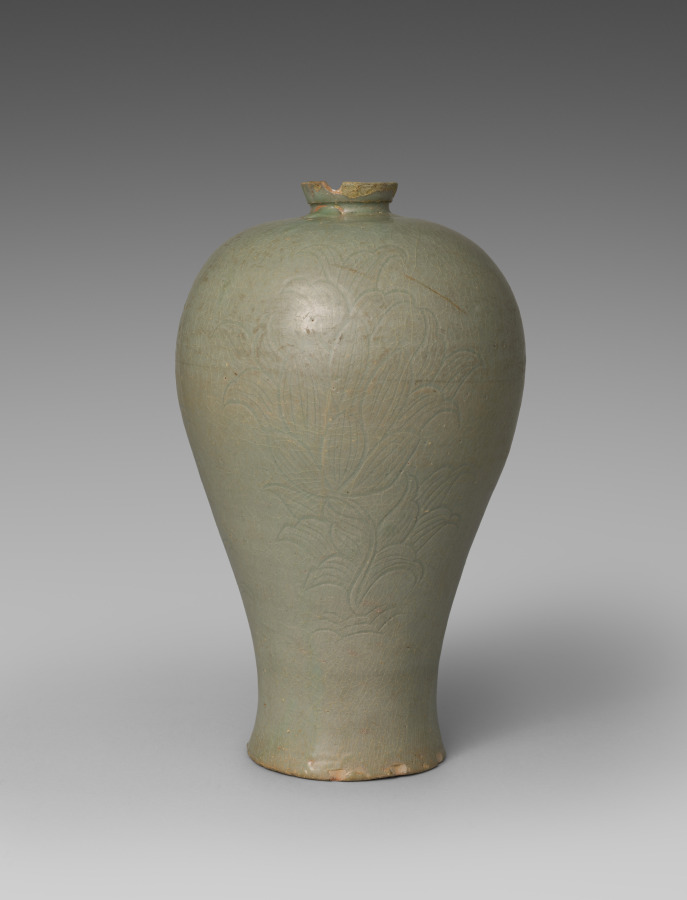
Prunus Vase with Incised Peony Design (1100s–1200s) is in the Cleveland Museum of Art collection.
The work and its context
The museum's open-access catalogue describes the work:
As early as the seventh century, the practice of drinking tea and wine became an important part of elite culture in Korea. Once used to store alcoholic beverages, this type of vase features a wide body followed by a sharply rounded shoulder, a short neck and a small opening. Most of the remaining examples no longer have a lid, but originally it may have had a lid that not only covered the opening, but also served as a cup.
Object facts
- Title: Prunus Vase with Incised Peony Design
- Date: 1100s–1200s
- Culture: Korea, Goryeo dynasty (918–1392)
- Type: Ceramic
- Technique: celadon
- Dimensions: Overall: 31.5 cm (12 3/8 in.)
- Collection: Korean Art
- Department: Korean Art
- Accession number: 1921.645
A detail from the museum
Prunus vases are often believed to contain a branch of plum blossoms, but recent researches reveal that these vases with a lid also were used to contain cooking liquid such as sesame oil.
Collection credit
Gift of John L. Severance
Further reading listed by the museum
- Yi, Jong-min. "A Study on the Celadons Maebyeong of the Goryeo Dynasty [고려시대 청자매병 연구]." Kangjwa misulsa (2006): 157-190.
- Goryeo Dynasty: Korea's Age of Enlightenment, 918-1392. San Francisco: Asian Art Museum, 2003.
- Goryeo: The Glory of Korea [대고려, 그 찬란한 도전]. Seoul: National Museum of Korea, 2018.
View the collection record
See the museum's photographs and full catalogue entry. Catalogue text is reproduced from the Cleveland Museum of Art's open-access data, with HTML formatting removed. This object and its supplied image are designated CC0.
Sources
More in Lifestyle
Keep reading
Related stories