Putti Pair (mid-1700s): Art, History and Details
Putti Pair at the Cleveland Museum of Art: mid-1700s, painted and gilded wood. Explore the work's context, creator attribution and collection history.
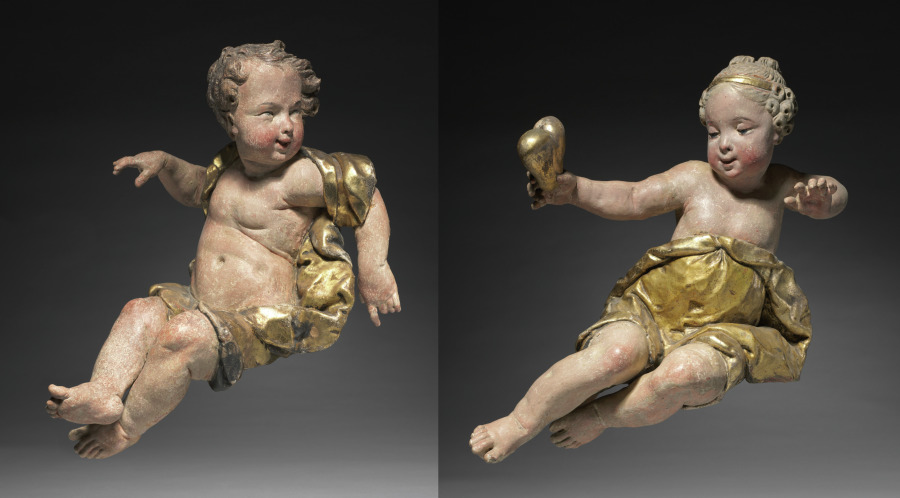
Putti Pair (mid-1700s) is in the Cleveland Museum of Art collection. The museum's creator attribution is Ferdinand Tietz (Austrian, 1708–1777).
The work and its context
The museum's open-access catalogue describes the work:
These airborne cherubs probably formed part of the decorations crowning an church altar. One of the putti holds a heart, which would originally have included a flame (now lost). An expression of religious fervor, the burning heart also referenced the Sacred Heart of Jesus, which in Christian imagery symbolized Christ’s love for humanity.
Object facts
- Title: Putti Pair
- Date: mid-1700s
- Creator attribution: Ferdinand Tietz (Austrian, 1708–1777)
- Culture: Germany, near Bamberg, 18th century
- Type: Sculpture
- Technique: painted and gilded wood
- Dimensions: Overall: 55.9 x 41.9 x 41.9 cm (22 x 16 1/2 x 16 1/2 in.)
- Collection: Sculpture
- Department: European Painting and Sculpture
- Accession number: 1971.8
Collection credit
John L. Severance Fund
Further reading listed by the museum
- "Year in Review" The Bulletin of The Cleveland Museum of Art LVIII, no.12 (December, 1971): 96.
- Lee, Sherman E. "The Year in Review for 1971." The Bulletin of the Cleveland Museum of Art 59, no. 1 (1972): 3-46.
- Henry Hawley, "Three Works by Ferdinand Tietz from Schloss Seehof," Bulletin of the Cleveland Museum of Art LIX (September 1972): 204-211.
View the collection record
See the museum's photographs and full catalogue entry. Catalogue text is reproduced from the Cleveland Museum of Art's open-access data, with HTML formatting removed. This object and its supplied image are designated CC0.
Sources
More in Lifestyle
Keep reading