Pyx (c. 1170–1180): Art, History and Details
Pyx at the Cleveland Museum of Art: c. 1170–1180, gilded copper, champlevé and cloisonné enamel, wood core (modern). Explore the work's context, creator attribution and collection history.
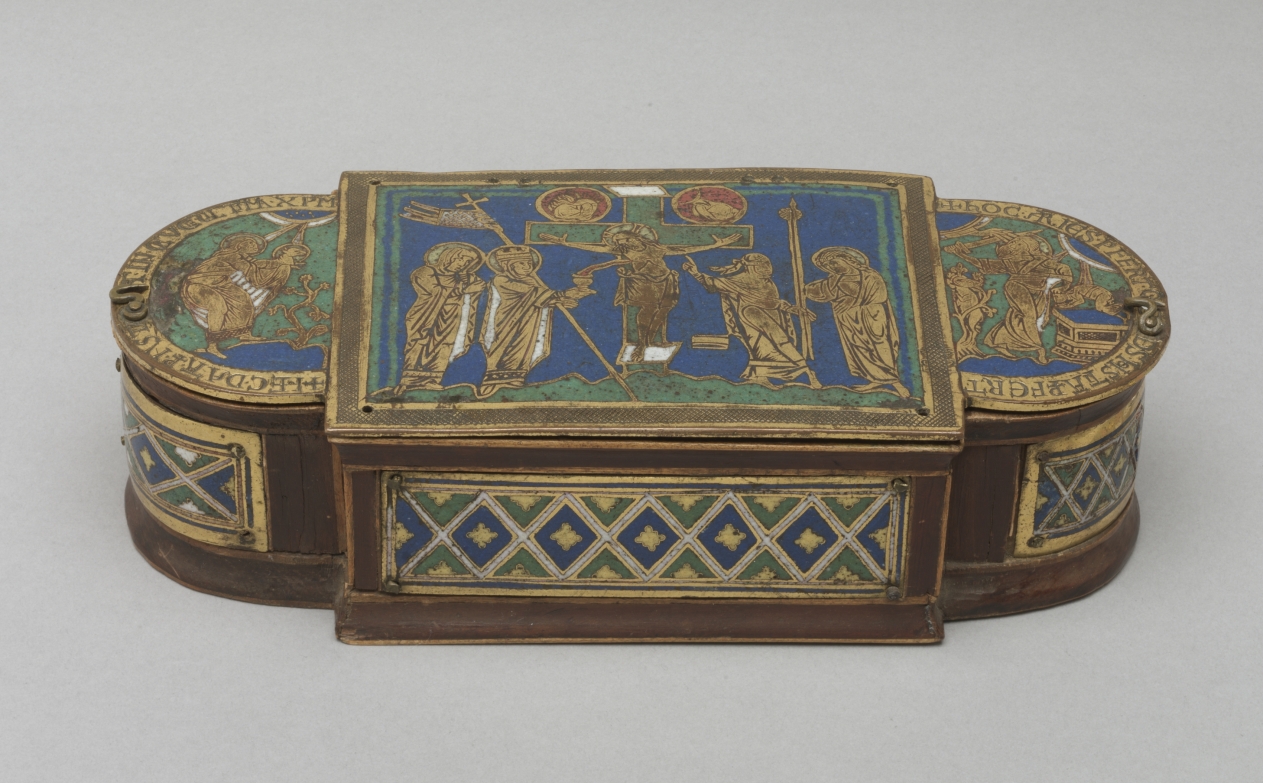
Pyx (c. 1170–1180) is in the Cleveland Museum of Art collection.
The work and its context
The museum's open-access catalogue describes the work:
The image of Christ’s crucifixion dominates this enameled box. Personifications of the Christian church, the Jewish faith, and the Virgin and Saint John flank the cross. Two Old Testament scenes--Abel’s sacrifice of sheep and Abraham’s sacrifice of Isaac--appear on either side. The box once served as a pyx, a container for the consecrated host, itself a symbol of Christ’s sacrifice.
Object facts
- Title: Pyx
- Date: c. 1170–1180
- Culture: Germany, Lower Saxony, Hildesheim?, Romanesque period, enamels: 12th century; wood core: 19th century
- Type: Enamel
- Technique: gilded copper, champlevé and cloisonné enamel, wood core (modern)
- Dimensions: Overall: 5.4 x 21.3 x 9.3 cm (2 1/8 x 8 3/8 x 3 11/16 in.)
- Collection: MED - Romanesque
- Department: Medieval Art
- Accession number: 1949.431
Collection credit
Purchase from the J. H. Wade Fund and the Fanny Tewksbury King Collection by exchange
Further reading listed by the museum
- Read, Herbert. "The Eumorfopoulos Collection: Western Objects-I." Apollo III, 16 (April 1926): 187-192.
- von Falke, Otto. "Hildesheimer Goldschmiedewerke des 12 Jahrhunderts im Welfenschatz." Pantheon V (June 1930): 266-274.
- Milliken, William M. “New Accessions of Champlevé Enamel.” The Bulletin of the Cleveland Museum of Art 36, no. 9 (November 1949): 167–70.
View the collection record
See the museum's photographs and full catalogue entry. Catalogue text is reproduced from the Cleveland Museum of Art's open-access data, with HTML formatting removed. This object and its supplied image are designated CC0.
Sources
More in Lifestyle
Keep reading