Qualities of Ringdoves (recto); On the Benefits of Quails (verso), from a Persian Manafi‘ al-Hayawan (The Benefits of Animals) of Abu Said Ubaid-Allah ibn Jibrail ibn Bakhtishu (died 1058–68) (c. 1300
Qualities of Ringdoves (recto); On the Benefits of Quails (verso), from a Persian Manafi‘ al-Hayawan (The Benefits of Animals) of Abu Said Ubaid-Allah ibn Jibrail ibn Bakhtishu (died 1058–68) at the Cleveland Museum of Art: c. 1300, opaque
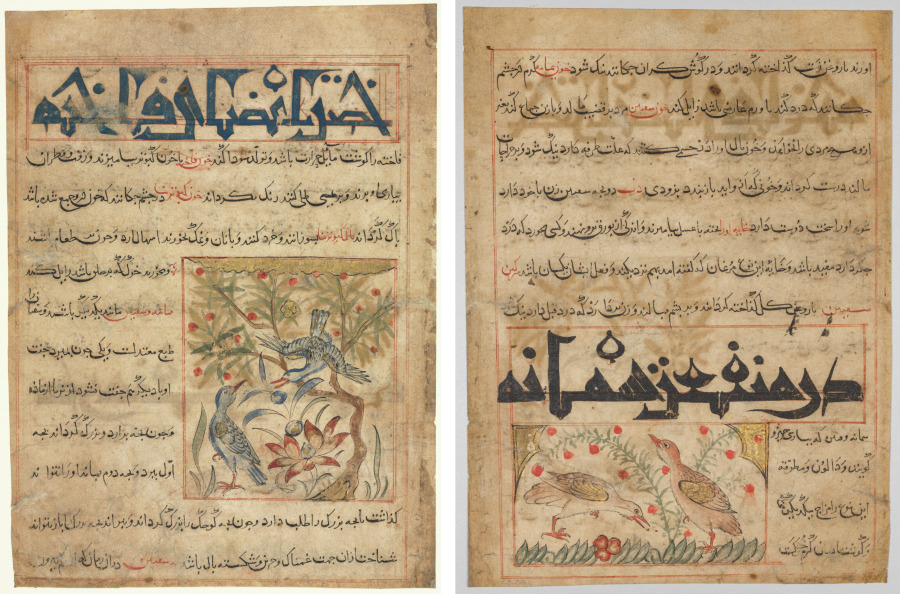
Qualities of Ringdoves (recto); On the Benefits of Quails (verso), from a Persian Manafi‘ al-Hayawan (The Benefits of Animals) of Abu Said Ubaid-Allah ibn Jibrail ibn Bakhtishu (died 1058–68) (c. 1300) is in the Cleveland Museum of Art collection.
The work and its context
The museum's open-access catalogue describes the work:
This small illustration of ringdoves incorporates the influence of Chinese naturalism in the drawing of the tree trunk and lotus blossom. In contrast, the reverse side is more traditional. The innovative page layouts feature cursive nashki script with bold angular kufic script headings. Derived from Aristotelian sources, this treatise deals with the physical characteristics and organs of animals. The text was translated into Persian from Arabic for the Ilkhanid ruler Ghazan Khan (reigned 1295–1304). Roughly a dozen pages from this long-lost manuscript are known. It is dated by comparison with a similar manuscript made at Maragha, near Tabriz, in 1297 or 1299.
Object facts
- Title: Qualities of Ringdoves (recto); On the Benefits of Quails (verso), from a Persian Manafi‘ al-Hayawan (The Benefits of Animals) of Abu Said Ubaid-Allah ibn Jibrail ibn Bakhtishu (died 1058–68)
- Date: c. 1300
- Culture: Iran, Maragah, Ilkhanid period (1256–1353)
- Type: Manuscript
- Technique: opaque watercolor, ink, and gold on paper
- Dimensions: Image: 10.2 x 9 cm (4 x 3 9/16 in.); Overall: 24.7 x 18.2 cm (9 3/4 x 7 3/16 in.); Text area: 22.2 x 16.5 cm (8 3/4 x 6 1/2 in.)
- Collection: Islamic Art
- Department: Islamic Art
- Accession number: 1945.382
Collection credit
Purchase from the J. H. Wade Fund
Further reading listed by the museum
- Wise, Deborah Sue. Ustād Mansur: the Artist and the Legend. 1975.
View the collection record
See the museum's photographs and full catalogue entry. Catalogue text is reproduced from the Cleveland Museum of Art's open-access data, with HTML formatting removed. This object and its supplied image are designated CC0.
Sources
More in Lifestyle
Keep reading