Quatrilobed Plaque (pair): The Annunciation and The Descent from the Cross (c. 1350–1400): Art, History and Details
Quatrilobed Plaque (pair): The Annunciation and The Descent from the Cross at the Cleveland Museum of Art: c. 1350–1400, translucent enamel (basse-taille) on silver. Explore the work's context, creator attribution and collection history.
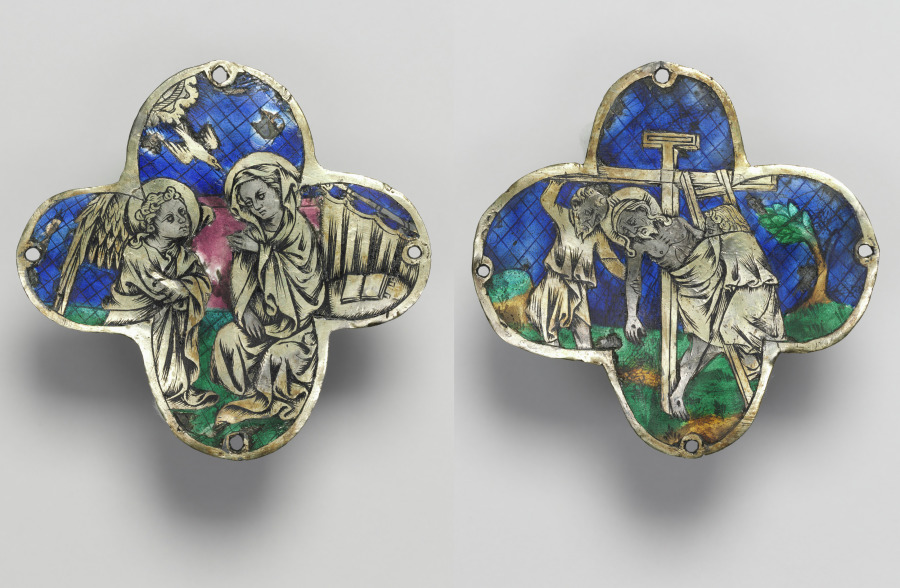
Quatrilobed Plaque (pair): The Annunciation and The Descent from the Cross (c. 1350–1400) is in the Cleveland Museum of Art collection.
The work and its context
The museum's open-access catalogue describes the work:
These plaques were probably originally placed at the end of the arms of a processional cross. They are decorated in an enameling technique called basse-taille in which colorful translucent enamel pastes are fused over an engraved and chased silver plaque.
Object facts
- Title: Quatrilobed Plaque (pair): The Annunciation and The Descent from the Cross
- Date: c. 1350–1400
- Culture: Spain, Catalonia?, 14th century
- Type: Enamel
- Technique: translucent enamel (basse-taille) on silver
- Dimensions: Overall: 8.3 x 8.3 cm (3 1/4 x 3 1/4 in.)
- Collection: MED - Gothic
- Department: Medieval Art
- Accession number: 1922.312
Collection credit
Gift of Mr. and Mrs. John L. Severance
Further reading listed by the museum
- “Gothic Art 1360-1440.” The Bulletin of the Cleveland Museum of Art 50, no. 7 (September 1963): 174–215.
- Richter, Rainer. "Between Original and Imitation: Four Technical Studies in Basse-Taille Enameling and Re-Enameling of the Historicism Period." The Bulletin of the Cleveland Museum of Art 81, no. 7 (1994): 222-51.
View the collection record
See the museum's photographs and full catalogue entry. Catalogue text is reproduced from the Cleveland Museum of Art's open-access data, with HTML formatting removed. This object and its supplied image are designated CC0.
Sources
More in Lifestyle
Keep reading