Raja Gulab Singh (1792–1857) of Jammu and Kashmir (c. 1830–40): Art, History and Details
Raja Gulab Singh (1792–1857) of Jammu and Kashmir at the Cleveland Museum of Art: c. 1830–40, Gum tempera, gold, and silver on paper. Explore the work's context, creator attribution and collection history.
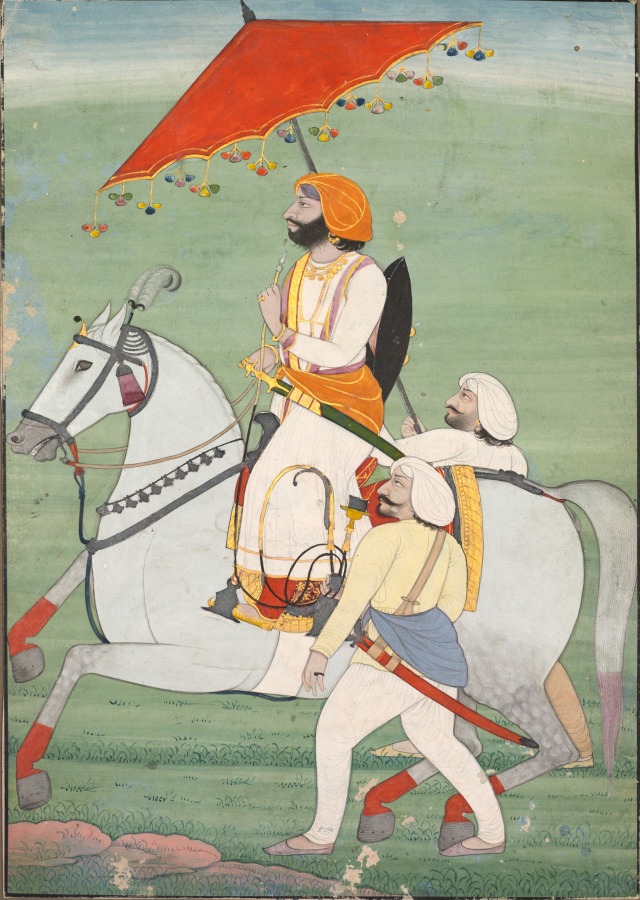
Raja Gulab Singh (1792–1857) of Jammu and Kashmir (c. 1830–40) is in the Cleveland Museum of Art collection.
The work and its context
The museum's open-access catalogue describes the work:
Raja Gulab Singh of the Dogra dynasty projects royal power by smoking a hookah carried alongside his horse. His umbrella signifies royalty, and the sword and shield indicate his status as a warrior. In 1846, he founded the princely state of Jammu and Kashmir, which he succeeded in expanding well into the Himalayas. Previously, he served as a military commander for the Sikhs, a religious group originating in India’s northwestern Punjab region. Though Hindu, this portrait depicts him without any visible indication of his religious affiliation. After the mid-1800s, fewer Pahari kings commissioned painted portraits, since most preferred the new medium of photography.
Object facts
- Title: Raja Gulab Singh (1792–1857) of Jammu and Kashmir
- Date: c. 1830–40
- Culture: Northern India, Pahari kingdoms
- Type: Painting
- Technique: Gum tempera, gold, and silver on paper
- Dimensions: Overall: 19.8 x 13.8 cm (7 13/16 x 5 7/16 in.)
- Collection: Indian Art
- Department: Indian and Southeast Asian Art
- Accession number: 1925.1338
A detail from the museum
Ananda K. Coomaraswamy (1877–1947), who sold this painting to the CMA, was a curator of Indian art at the Museum of Fine Arts, Boston and a prolific author of art historical and philosophical works.
Collection credit
Gift of J. H. Wade
Further reading listed by the museum
- Leach, Linda York. Indian Miniature Paintings and Drawings. Cleveland, OH: Cleveland Museum of Art in cooperation with Indiana University Press, 1986.
View the collection record
See the museum's photographs and full catalogue entry. Catalogue text is reproduced from the Cleveland Museum of Art's open-access data, with HTML formatting removed. This object and its supplied image are designated CC0.
Sources
More in Lifestyle
Keep reading