Rapier (c.1625–50): Art, History and Details
Rapier at the Cleveland Museum of Art: c.1625–50, steel; hilt russeted; wire grip. Explore the work's context, creator attribution and collection history.
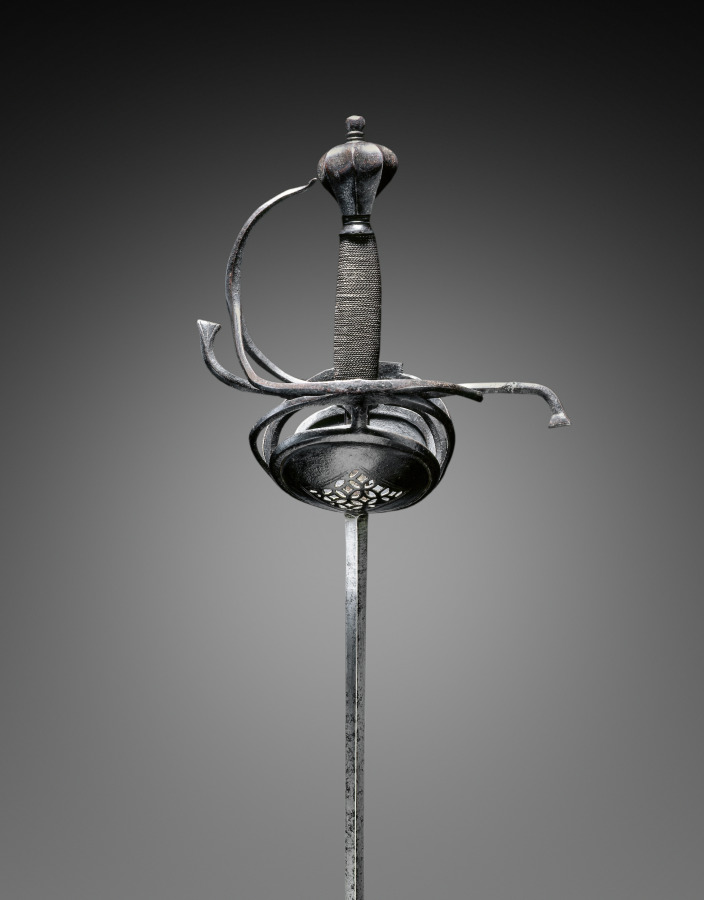
Rapier (c.1625–50) is in the Cleveland Museum of Art collection. The museum's creator attribution is Federico Picinino (Italian).
The work and its context
The museum's open-access catalogue describes the work:
The rapier was a sword worn with civilian dress and used in duels. The term rapier derives from the 16th-century French word rapière, which in turn was derived from the Spanish espada ropera, or “dress sword.” The rapier was a light weapon with a straight double-edged and pointed blade that, with the development of the art of fencing in the 1500s and 1600s, gradually became narrower and lighter, and thus suitable for thrusts only. With the new technique of swordplay emphasizing the point of the blade, sword guards became more complex to protect the duelist’s unarmored hand. These elaborate guards were frequently decorated by various techniques—chiseling, bluing, russeting, and damascening.
Object facts
- Title: Rapier
- Date: c.1625–50
- Creator attribution: Federico Picinino (Italian)
- Culture: Italy, Milan
- Type: Arms and Armor
- Technique: steel; hilt russeted; wire grip
- Dimensions: Overall: 144.8 cm (57 in.); Quillions: 22.5 cm (8 7/8 in.)
- Collection: MED - Arms & Armor
- Department: Medieval Art
- Accession number: 1916.695
Collection credit
Gift of Mr. and Mrs. John L. Severance
Further reading listed by the museum
- Catalogue of Arms and Armour. Vol. 2, 16th century. [Boston, Massachusetts]: [Frank Gair Macomber], [1900-1915].
- Gilchrist, Helen Ives. A Catalogue of the Collection of Arms & Armor Presented to the Cleveland Museum of Art by Mr. and Mrs. John Long Severance; 1916-1923. Cleveland: The Cleveland Museum of Art, 1924.
- Cleveland Museum of Art, and Helen Ives Gilchrist. Handbook of the Severance Collection of Arms and Armor. 2d ed., 1948.
View the collection record
See the museum's photographs and full catalogue entry. Catalogue text is reproduced from the Cleveland Museum of Art's open-access data, with HTML formatting removed. This object and its supplied image are designated CC0.
Sources
More in Lifestyle
Keep reading
Related stories


