Returning Home (mid-1500s): Art, History and Details
Returning Home at the Cleveland Museum of Art: mid-1500s, hanging scroll, ink and color on paper. Explore the work's context, creator attribution and collection history.
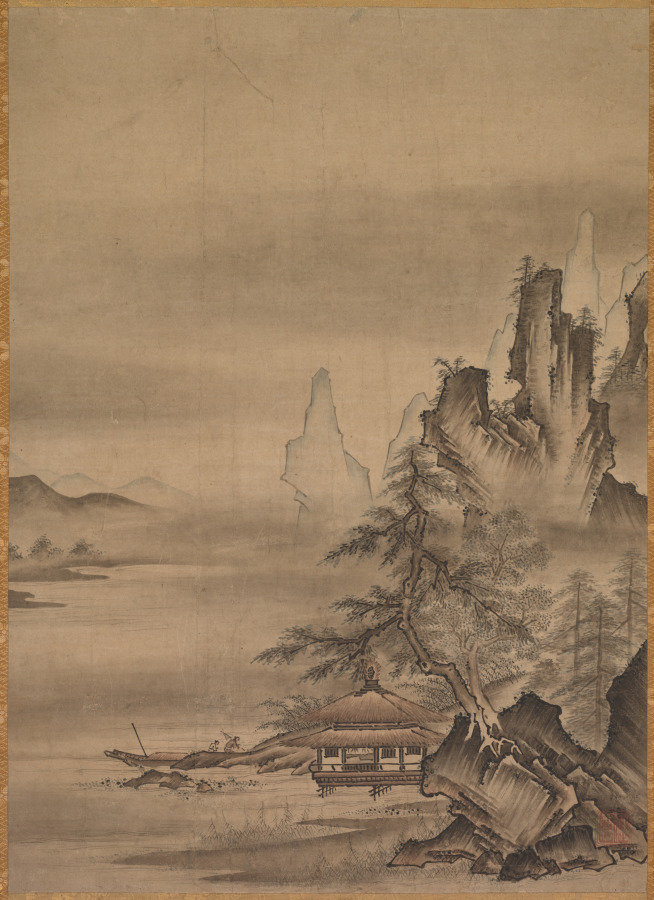
Returning Home (mid-1500s) is in the Cleveland Museum of Art collection.
The work and its context
The museum's open-access catalogue describes the work:
This painting bears a seal reading Shōkei. The style of the seal resembles that used by Kenkō Shōkei (active about 1470–after 1523), a monk and painter at the Zen temple Kenchōji in Kamakura who studied in Kyoto for three years with Geiami (1431–1485?), painter to the shogun as well as curator of the shogun’s collection of art. However, the seal was carved to look like Shōkei’s and added to the painting at a later date by someone who thought the unsigned landscape was similar to his work. The painting has compositional and some stylistic similarities to images by other Kanto-based artists like Maejima Sōyū (active mid-1500s), who trained with Kano school artists. Specifically, the pines clinging to the massive boulder in front of a pavilion with mountains receding into atmospheric space—in a composition weighted in a single corner of the painting—is a Kanto-inflected derivation of the painting of the Zen monk-painter Tenshō Shūbun (active about 1414), whose work was a major inspiration for Kano school painters.
Object facts
- Title: Returning Home
- Date: mid-1500s
- Culture: Japan, Muromachi period (1392–1573)
- Type: Painting
- Technique: hanging scroll, ink and color on paper
- Dimensions: Mounted: 165.1 x 55.9 cm (65 x 22 in.)
- Collection: ASIAN - Hanging scroll
- Department: Japanese Art
- Accession number: 2015.513
Collection credit
Gift from the Collection of George Gund III
View the collection record
See the museum's photographs and full catalogue entry. Catalogue text is reproduced from the Cleveland Museum of Art's open-access data, with HTML formatting removed. This object and its supplied image are designated CC0.
Sources
More in Lifestyle
Keep reading