Reverberations of Taiga, Volume 2 (leaf 7) (mid-1700s–1802): Art, History and Details
Reverberations of Taiga, Volume 2 (leaf 7) at the Cleveland Museum of Art: mid-1700s–1802, double-leaf from a pair of albums; ink and light color on paper. Explore the work's context, creator attribution and collection history.
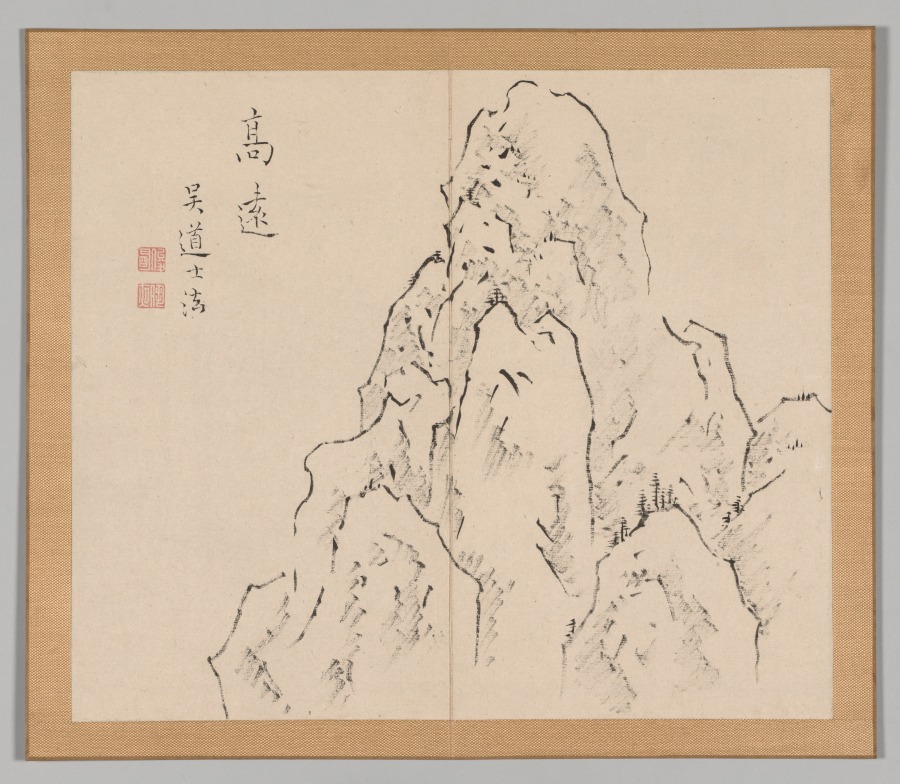
Reverberations of Taiga, Volume 2 (leaf 7) (mid-1700s–1802) is in the Cleveland Museum of Art collection. The museum's creator attribution is Aoki Shukuya (Japanese, d. 1802).
The work and its context
The museum's open-access catalogue describes the work:
Aoki Shukuya was a top student of painter Ike Taiga and took responsibility for Taiga’s stylistic legacy. A painting album by Taiga, part of which survives today in Kyoto in hanging scroll format, served as the source for this painting by Shukuya and the matching designs from a set of wood-block–printed volumes published in 1804. The postscript to the books, written and carved by the scholar Minagawa Kien (皆川淇園) (1735–1807), explains that Taiga produced the original album for his wife and fellow painter Tokuyama Gyokuran (徳山玉瀾) (1727/28–1784). The third volume of the wood-block–printed books contains an image of a tall mountain peak with the text “high and distant” (高遠) to its left. Shukuya’s version of this design includes additional words—he wrote that the design represents the method of Wu Daozi (吳道子) (Chinese, about 689–759). Revered as one of the most important Tang-dynasty painters, Wu Daozi’s work is known today only through copies.
Object facts
- Title: Reverberations of Taiga, Volume 2 (leaf 7)
- Date: mid-1700s–1802
- Creator attribution: Aoki Shukuya (Japanese, d. 1802)
- Culture: Japan, Edo period (1615–1868)
- Type: Portfolio
- Technique: double-leaf from a pair of albums; ink and light color on paper
- Dimensions: Album, closed: 28.3 x 33 cm (11 1/8 x 13 in.)
- Collection: Japanese Art
- Department: Japanese Art
- Accession number: 1979.73.2.7
A detail from the museum
Traditionally, young painters in Japan began their studies with an established master painter. The master's compositions invariably became models that the apprentice copied to learn various ink and brush techniques.
Collection credit
Andrew R. and Martha Holden Jennings Fund
Further reading listed by the museum
- Lee, Sherman E. “The Year in Review for 1979.” The Bulletin of the Cleveland Museum of Art 67, no. 3 (March 1980): 58–99.
- Graham, Patricia J. "Lifestyles of Scholar-Painters in Edo Japan." The Bulletin of the Cleveland Museum of Art 77, no. 7 (September 1990): 262–283.
View the collection record
See the museum's photographs and full catalogue entry. Catalogue text is reproduced from the Cleveland Museum of Art's open-access data, with HTML formatting removed. This object and its supplied image are designated CC0.
Sources
More in Lifestyle
Keep reading