Rider (c. 400–375 BCE): Art, History and Details
Rider at the Cleveland Museum of Art: c. 400–375 BCE, bronze. Explore the work's context, creator attribution and collection history.
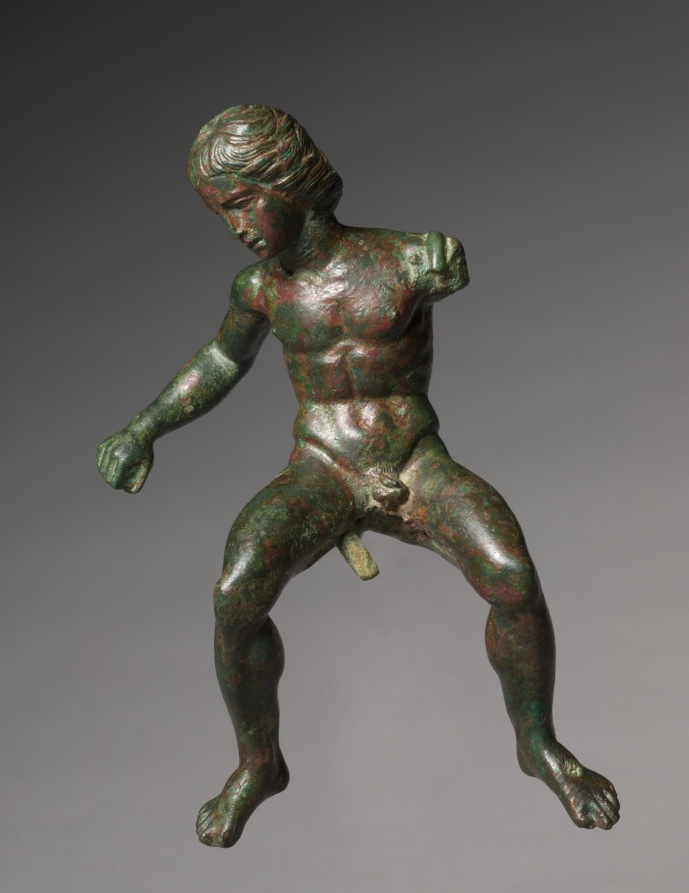
Rider (c. 400–375 BCE) is in the Cleveland Museum of Art collection.
The work and its context
The museum's open-access catalogue describes the work:
Once mounted with pins upon his horse (now lost), this statuette depicts a young man participating in an equestrian race. The rider’s distinctive equipment is still barely visible: his right hand clutches the base of a goad to urge on his horse, and the first pleat of a cloak, the youth’s only covering, lays over his left shoulder.
Object facts
- Title: Rider
- Date: c. 400–375 BCE
- Culture: Greece, perhaps from workshop of Tarentum
- Type: Sculpture
- Technique: bronze
- Dimensions: Overall: 13.3 x 7.6 cm (5 1/4 x 3 in.)
- Collection: GR - Greek
- Department: Greek and Roman Art
- Accession number: 1977.41
A detail from the museum
Without stirrups, this rider’s heels turn inward to control his mount by pressing its flanks.
Collection credit
Purchase from the J. H. Wade Fund
Further reading listed by the museum
- Pevnick, Seth. "Ancient Artworks Echo the Origins of the Olympic Games," Medium (July 2021).
- The Cleveland Museum of Art. Handbook of the Cleveland Museum of Art/1978. Cleveland, OH: The Cleveland Museum of Art, 1978.
- Neils, Jenifer. "A Horseman from Tarentum." The Bulletin of the Cleveland Museum of Art 68, no. 9 (1981): 331-38.
View the collection record
See the museum's photographs and full catalogue entry. Catalogue text is reproduced from the Cleveland Museum of Art's open-access data, with HTML formatting removed. This object and its supplied image are designated CC0.
Sources
More in Lifestyle
Keep reading