Righteousness, from The Five Virtues (1767): Art, History and Details
Righteousness, from The Five Virtues at the Cleveland Museum of Art: 1767, color woodblock print. Explore the work's context, creator attribution and collection history.
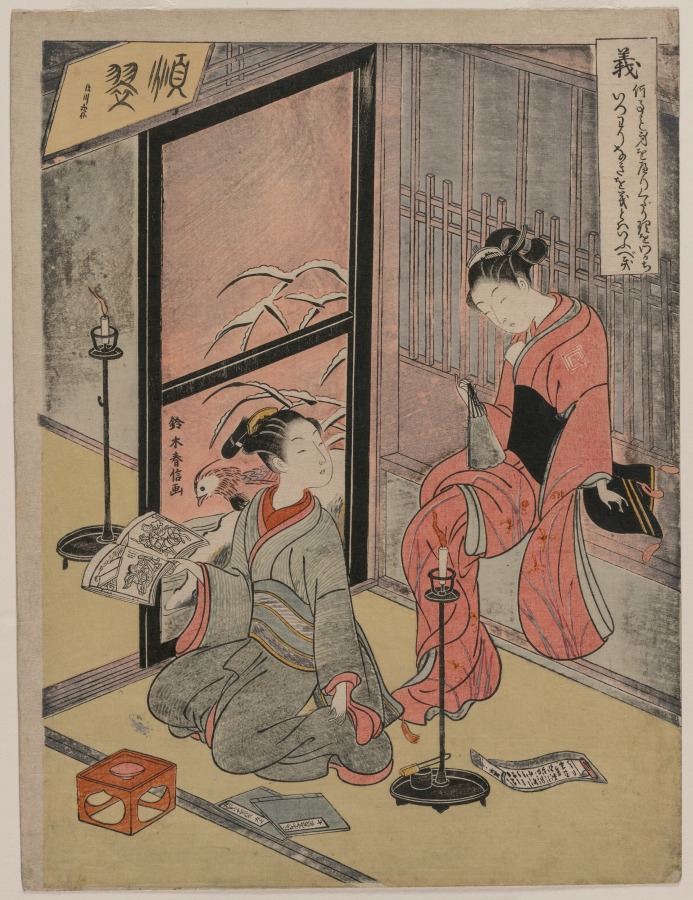
Righteousness, from The Five Virtues (1767) is in the Cleveland Museum of Art collection. The museum's creator attribution is Suzuki Harunobu (Japanese, 1724–1770).
The work and its context
The museum's open-access catalogue describes the work:
Two young male courtesans enjoy reading in their quarters by candlelight. One holds an illustrated book recognizable as the drawing manual Illustrated Book of the Treasure-Bag of Sketches (絵本写宝袋), published in 1720 by Tachibana Morikuni (1679–1748). The poem at the top translates as follows: In all things to be humble, discern the path of reason, and abstain from falsehood. This is what we call righteousness.
Object facts
- Title: Righteousness, from The Five Virtues
- Date: 1767
- Creator attribution: Suzuki Harunobu (Japanese, 1724–1770)
- Culture: Japan, Edo period (1615–1868)
- Type: Print
- Technique: color woodblock print
- Dimensions: Overall: 36.6 x 21.6 cm (14 7/16 x 8 1/2 in.)
- Collection: Japanese Art
- Department: Japanese Art
- Accession number: 1985.307
A detail from the museum
The artist's signature is on the door painted with a mandarin drake in a snowy scene.
Collection credit
The Kelvin Smith Collection, given by Mrs. Kelvin Smith
Further reading listed by the museum
- Stern, Harold P. Master Prints of Japan: Ukiyo-E Hanga. New York: Abrams, 1969.
- “Checklist of the Kelvin Smith Bequest.” The Bulletin of the Cleveland Museum of Art, vol. 75, no. 7, 1988, pp. 292–295.
View the collection record
See the museum's photographs and full catalogue entry. Catalogue text is reproduced from the Cleveland Museum of Art's open-access data, with HTML formatting removed. This object and its supplied image are designated CC0.
Sources
More in Lifestyle
Keep reading