Ritual Drum (damaru) (c. 1800): Art, History and Details
Ritual Drum (damaru) at the Cleveland Museum of Art: c. 1800, skull bone, cloth, hemp fiber, leather, and skin. Explore the work's context, creator attribution and collection history.
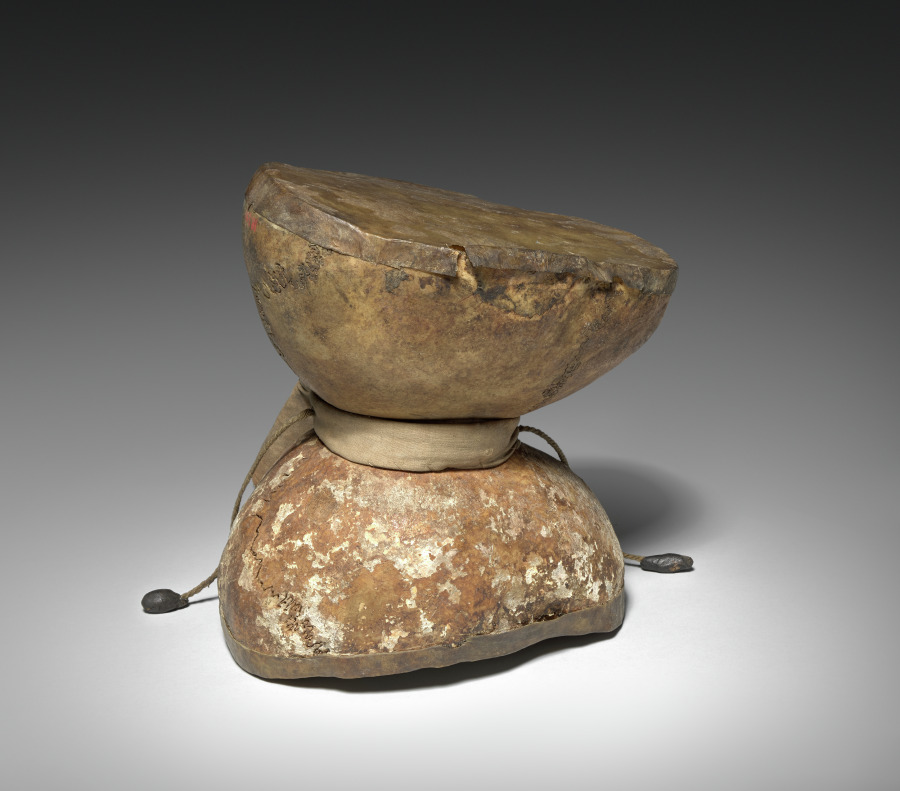
Ritual Drum (damaru) (c. 1800) is in the Cleveland Museum of Art collection.
The work and its context
The museum's open-access catalogue describes the work:
Damaru drums are made from the tops of two skulls joined in the center and sounded by rapidly turning it side to side so the ends of the cords fly up to sound against the stretched skin. In Hindu and Buddhist rituals, the rhythm of the damaru references the ongoing, relentless beat of time. The material of bone reminds practitioners of the inevitability of death in the course of time.
Object facts
- Title: Ritual Drum (damaru)
- Date: c. 1800
- Culture: Tibet
- Type: Musical Instrument
- Technique: skull bone, cloth, hemp fiber, leather, and skin
- Dimensions: Overall: 20.4 x 17.8 x 13.1 cm (8 1/16 x 7 x 5 3/16 in.)
- Collection: Tibetan Art
- Department: Indian and Southeast Asian Art
- Accession number: 1918.391
A detail from the museum
Dancing Shiva, in his form as Nataraja, holds a damaru in one hand.
Collection credit
The Charles G. King Jr. collection; Gift of Ralph King in memory of Charles G. King Jr.
Further reading listed by the museum
- "Accessions." The Bulletin of the Cleveland Museum of Art 5, no. 8/9 (1918): 82-85.
- D. S. M. "Exhibition of Musical Instruments." The Bulletin of the Cleveland Museum of Art 8, no. 9 (1921): 134-43.
View the collection record
See the museum's photographs and full catalogue entry. Catalogue text is reproduced from the Cleveland Museum of Art's open-access data, with HTML formatting removed. This object and its supplied image are designated CC0.
Sources
More in Lifestyle
Keep reading