Roundel from a Curtain (300s CE): Art, History and Details
Roundel from a Curtain at the Cleveland Museum of Art: 300s CE, plain weave ground with tapestry weave and supplementary weft wrapping; undyed linen and dyed wool. Explore the work's context, creator attribution and collection history.
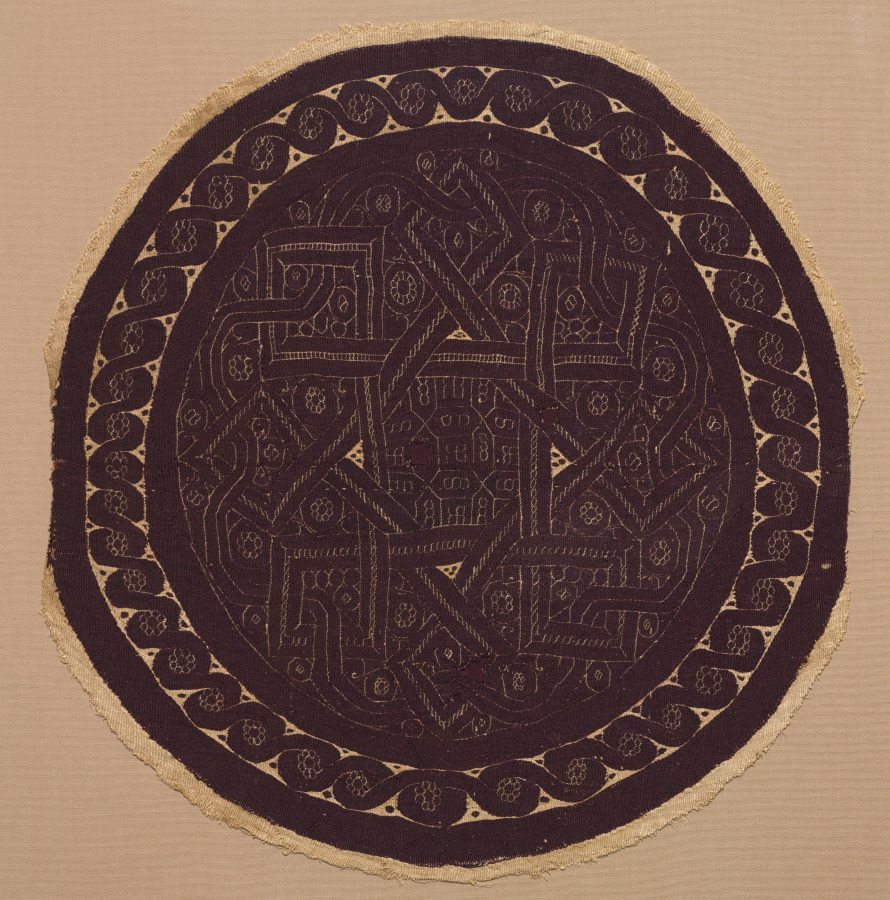
Roundel from a Curtain (300s CE) is in the Cleveland Museum of Art collection.
The work and its context
The museum's open-access catalogue describes the work:
This circular element called a roundel that originally decorated a curtain displays a perfectly interlaced knot, a design believed to provide protection from harm. Curtains were often used as modular walls in houses, theaters, and Christian churches during the late Roman and early Christian periods.
Object facts
- Title: Roundel from a Curtain
- Date: 300s CE
- Culture: Egypt, Byzantine period
- Type: Textile
- Technique: plain weave ground with tapestry weave and supplementary weft wrapping; undyed linen and dyed wool
- Dimensions: Overall: 45.2 x 47.7 cm (17 13/16 x 18 3/4 in.); Mounted: 64.1 x 64.1 x 2.5 cm (25 1/4 x 25 1/4 x 1 in.)
- Collection: T - Coptic
- Department: Textiles
- Accession number: 1946.412
A detail from the museum
The purple color was achieved with kermes, a dye derived from the dried bodies of insects of the same name.
Collection credit
Gift of Henry Hunt Clark
Further reading listed by the museum
- Sims, Lowery Stokes. The persistence of geometry: form, content, and culture in the collection of the Cleveland Museum of Art. Cleveland: Cleveland Museum of Art, 2006.
- Thomas, Thelma K. "Making Textiles and Assessing Their Value." In Designing Identity: The Power of Textiles in Late Antiquity. Thelma K. Thomas, ed. Princeton: Princeton University Press, 2016.
View the collection record
See the museum's photographs and full catalogue entry. Catalogue text is reproduced from the Cleveland Museum of Art's open-access data, with HTML formatting removed. This object and its supplied image are designated CC0.
Sources
More in Lifestyle
Keep reading