Roundels with camels bearing howdahs (900s–1000s): Art, History and Details
Roundels with camels bearing howdahs at the Cleveland Museum of Art: 900s–1000s, silk: plain weave variation with supplementary weft. Explore the work's context, creator attribution and collection history.
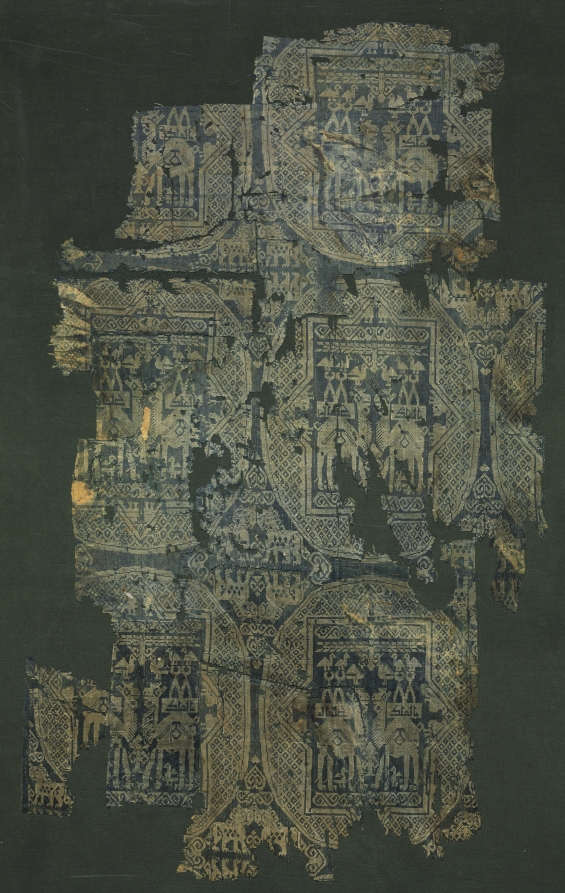
Roundels with camels bearing howdahs (900s–1000s) is in the Cleveland Museum of Art collection.
The work and its context
The museum's open-access catalogue describes the work:
This unusually large fragment is part of a rare group of silks characterized by an unusal weave structure. The group is most important, however, because the Kufic inscriptions (here "mulk," or "Dominion," an abbreviation of "al-mulk lillah," meaning "Dominion belongs to God") demonstrates their Islamic origin. The Byzantine motifs found in some of them (for example, a second fragment in the museum collection), however, lead scholars to believe they may have been woven in Antioch, the scene of much fighting between Muslims and the Crusaders. These fragments become, therefore, fascinating evidence of two traditions occurring in one area.
Object facts
- Title: Roundels with camels bearing howdahs
- Date: 900s–1000s
- Culture: Syria (?), 900s - 1000s
- Type: Textile
- Technique: silk: plain weave variation with supplementary weft
- Dimensions: Overall: 78.8 x 48.6 cm (31 x 19 1/8 in.)
- Collection: T - Islamic
- Department: Textiles
- Accession number: 1986.90
Collection credit
Purchase from the J. H. Wade Fund
Further reading listed by the museum
- Turner, Evan H. “The Year in Review for 1986.” The Bulletin of the Cleveland Museum of Art 74, no. 2 (1987): 38–79.
- Wilckens, Leonie von. Die textilen Künste: von der Spätantike bis um 1500. München: C.H. Beck, 1991.
- Mackie, Louise W. Symbols of Power: Luxury Textiles from Islamic Lands, 7th-21st Century. Cleveland, OH; New Haven, CT: The Cleveland Museum of Art; Yale University Press, 2015.
View the collection record
See the museum's photographs and full catalogue entry. Catalogue text is reproduced from the Cleveland Museum of Art's open-access data, with HTML formatting removed. This object and its supplied image are designated CC0.
Sources
More in Lifestyle
Keep reading