Royal ceremonial beadwork: anklet (izitsaba) (1800s): Art, History and Details
Royal ceremonial beadwork: anklet (izitsaba) at the Cleveland Museum of Art: 1800s, Glass beads and sinew. Explore the work's context, creator attribution and collection history.
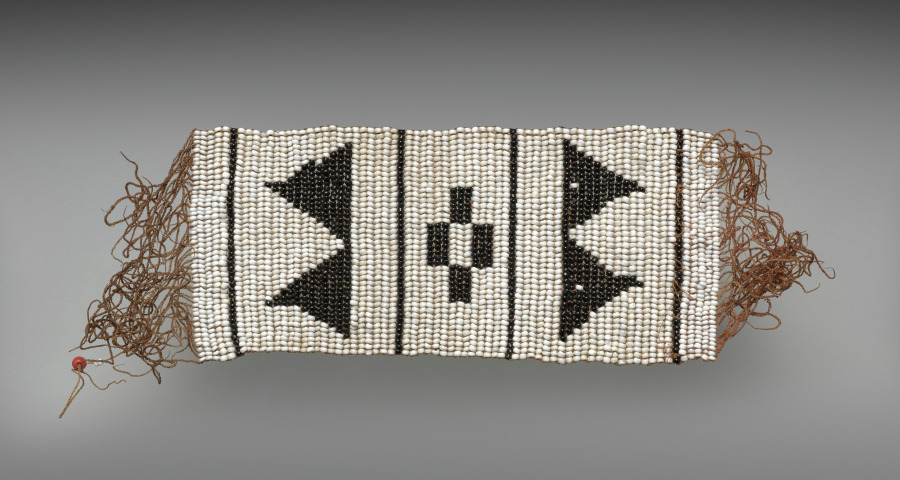
Royal ceremonial beadwork: anklet (izitsaba) (1800s) is in the Cleveland Museum of Art collection.
The work and its context
The museum's open-access catalogue describes the work:
Elite Xhosa women once wore beaded garments like this on festive occasions. Made almost completely from imported Venetian or Bohemian glass beads, they were overt status symbols. Imported beads functioned as money for the Xhosa between about 1770 and 1829. These garments’ female maker carefully selected beads of the highest quality, uniform in color, shape, and size. Made in the same shape as the pendant, a swallowtail-shaped apron (CMA 2010.206) worn under the skirt completed the ensemble.
Object facts
- Title: Royal ceremonial beadwork: anklet (izitsaba)
- Date: 1800s
- Culture: Africa, Southern Africa, South Africa, Southeast Cape Region, Unknown female Xhosa-style maker(s)
- Type: Mixed Media
- Technique: Glass beads and sinew
- Dimensions: Overall: 27.9 x 8.9 cm (11 x 3 1/2 in.)
- Collection: African Art
- Department: African Art
- Accession number: 2022.49.e
A detail from the museum
The beads to make an ensemble like this cost several cattle in the early 1800s, an amount most couldn't afford.
Collection credit
Severance and Greta Millikin Trust
Further reading listed by the museum
- Pemberton, John. African Beaded Art: Power and Adornment. Northampton, Mass: Smith College Museum of Art, 2008.
View the collection record
See the museum's photographs and full catalogue entry. Catalogue text is reproduced from the Cleveland Museum of Art's open-access data, with HTML formatting removed. This object and its supplied image are designated CC0.
Sources
More in Lifestyle
Keep reading