Rumal with Rama and Krishna scenes (1700s): Art, History and Details
Rumal with Rama and Krishna scenes at the Cleveland Museum of Art: 1700s, Silk and silver wire on cotton; embroidery. Explore the work's context, creator attribution and collection history.
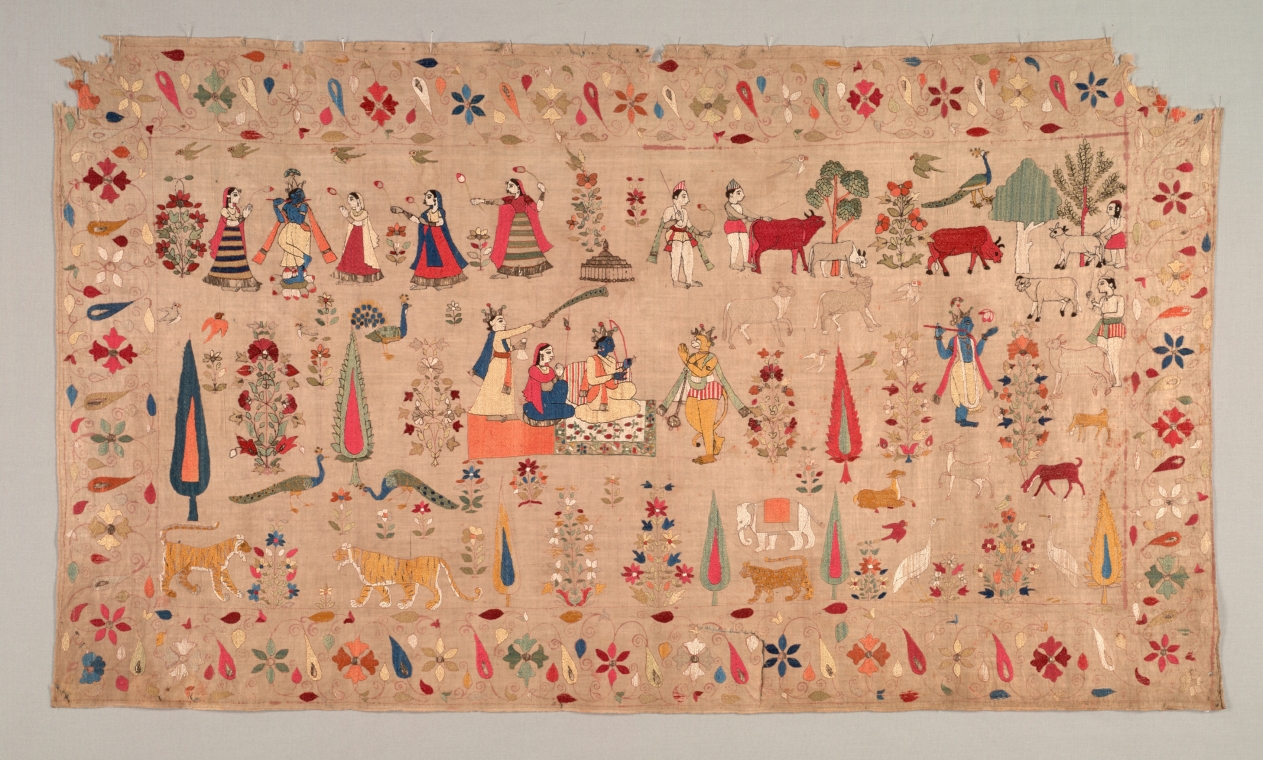
Rumal with Rama and Krishna scenes (1700s) is in the Cleveland Museum of Art collection.
The work and its context
The museum's open-access catalogue describes the work:
Rumal refers to a double-sided embroidery technique perfected by women in the Pahari region of the northwest Himalayas. Unlike other forms of embroidery, no knots or loose strings are visible. Rumals were intended to look like paintings on cloth. An artist who was skilled in making Pahari paintings drew outlines of the composition with a brush on hand-loomed cotton muslin fabric and noted the colors to be used. Women then used a type of stitch called “double satin stitch” to create flat planes of color on both sides of the fabric. Girls were responsible for winding the silk threads into multistrand embroidery floss. Rumals were treasured as objects of wealth and given as gifts during weddings or state ceremonies. Many rumals depict subjects drawn from Hindu devotional literature. In the center, the semidivine monkey general Hanuman pays his respects to his lord Rama, Rama’s wife Sita, and Rama’s brother Lakshmana. Surrounding them above and to the right are bucolic rural scenes from the life of Krishna, another human incarnation of the god Vishnu. Krishna with his flute serenades the gopis (women of the cow herding community) and entertains his friends the cowherd boys (gopas). Flowering plants, vines, and wild animals populate the remaining space and borders. With such scenes, the painstaking act of double-sided embroidery becomes a devotional endeavor that generates religious merit.
Object facts
- Title: Rumal with Rama and Krishna scenes
- Date: 1700s
- Culture: Northern India, Pahari Kingdom of Chamba
- Type: Embroidery
- Technique: Silk and silver wire on cotton; embroidery
- Dimensions: Overall: 64.5 x 114 cm (25 3/8 x 44 7/8 in.)
- Collection: Textiles
- Department: Textiles
- Accession number: 1996.349
A detail from the museum
Especially in the borders, some of the embroidery has fallen away, revealing the brushwork of the designer.
Collection credit
Gift of William E. Ward in memory of his wife, Evelyn Svec Ward
View the collection record
See the museum's photographs and full catalogue entry. Catalogue text is reproduced from the Cleveland Museum of Art's open-access data, with HTML formatting removed. This object and its supplied image are designated CC0.
Sources
More in Lifestyle
Keep reading