Sacrificial Fire, from the "Tula Ram" Bhagavata Purana (c. 1720): Art, History and Details
Sacrificial Fire, from the "Tula Ram" Bhagavata Purana at the Cleveland Museum of Art: c. 1720, Gum tempera, ink, and gold on paper. Explore the work's context, creator attribution and collection history.
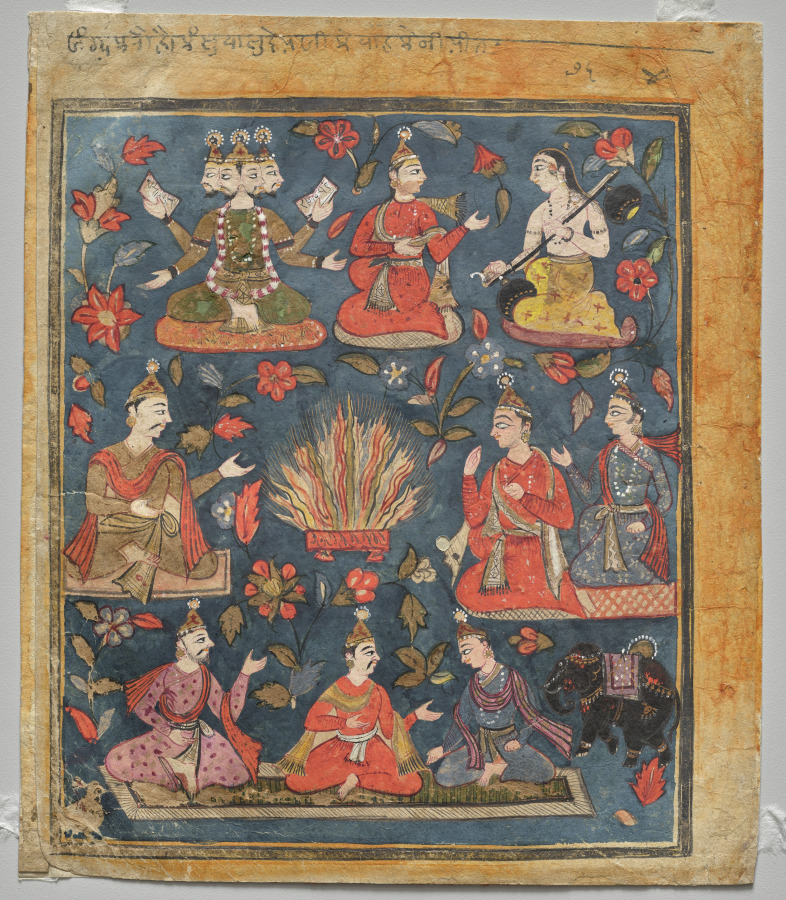
Sacrificial Fire, from the "Tula Ram" Bhagavata Purana (c. 1720) is in the Cleveland Museum of Art collection.
The work and its context
The museum's open-access catalogue describes the work:
The evil king Kamsa organized a fire sacrifice in order to bring about the death of his brother-in-law, Vasudeva, father of the Hindu god incarnated as Krishna. The four-armed god of creation, Brahma, attends at the upper left with the sage, or holy man, Narada at the upper right. Scholars have linked the copious floral motifs throughout this dispersed series with textile patterns. This series was created in a port city, the center of flourishing international textile trade.
Object facts
- Title: Sacrificial Fire, from the "Tula Ram" Bhagavata Purana
- Date: c. 1720
- Culture: Western India, Gujarat, Surat
- Type: Painting
- Technique: Gum tempera, ink, and gold on paper
- Dimensions: Overall: 25.4 x 21.5 cm (10 x 8 7/16 in.)
- Collection: Indian Art
- Department: Indian and Southeast Asian Art
- Accession number: 1990.40
A detail from the museum
The sage Narada in the upper right corner plays a stringed instrument called a vina.
Collection credit
Gift of John D. Proctor
Further reading listed by the museum
- Czuma, Stanislaw J. Indian Art from the George P. Bickford Collection: Catalog. Cleveland, OH: The Cleveland Museum of Art, 1975.
View the collection record
See the museum's photographs and full catalogue entry. Catalogue text is reproduced from the Cleveland Museum of Art's open-access data, with HTML formatting removed. This object and its supplied image are designated CC0.
Sources
More in Lifestyle
Keep reading