Saint Agostino from Bulagajo, Perugia (San Agostino dalla parte del Bulagajo, Perugia) (1829): Art, History and Details
Saint Agostino from Bulagajo, Perugia (San Agostino dalla parte del Bulagajo, Perugia) at the Cleveland Museum of Art: 1829, graphite. Explore the work's context, creator attribution and collection history.
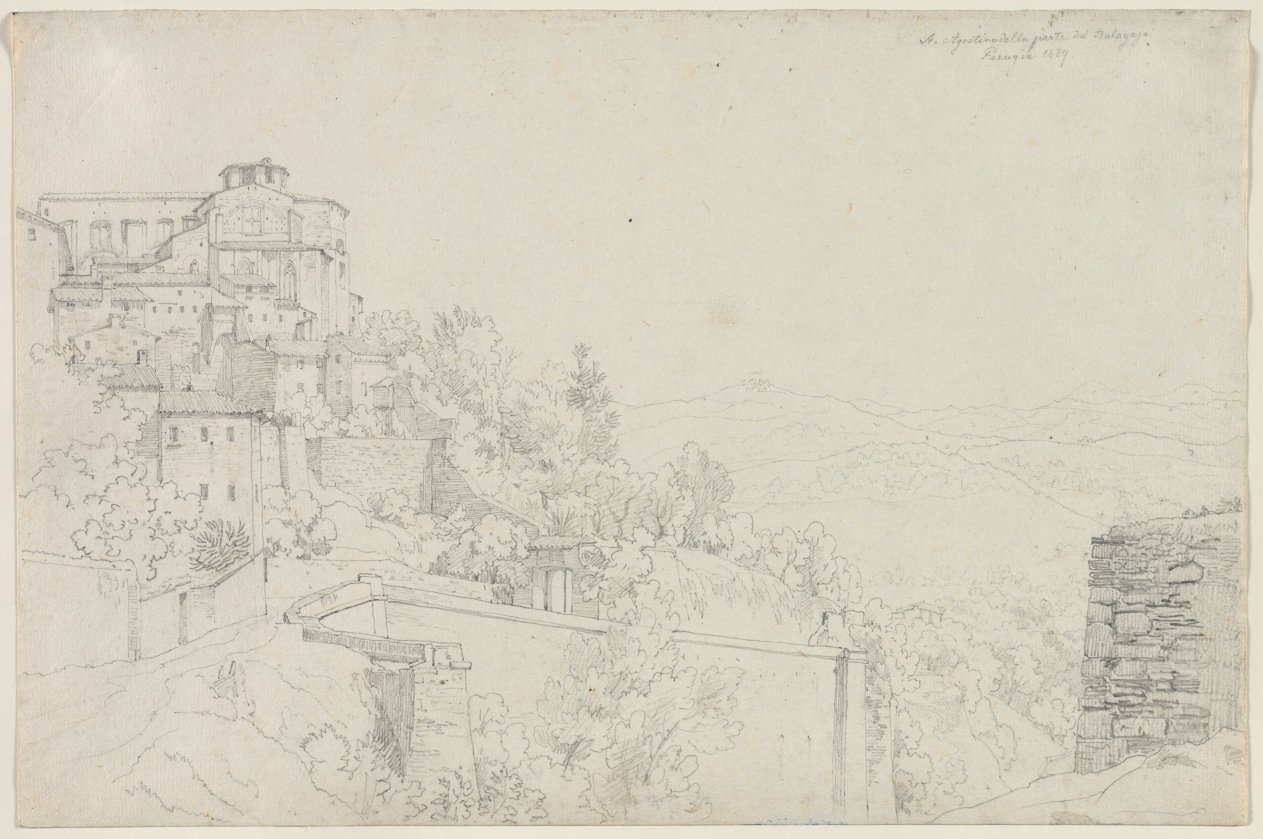
Saint Agostino from Bulagajo, Perugia (San Agostino dalla parte del Bulagajo, Perugia) (1829) is in the Cleveland Museum of Art collection. The museum's creator attribution is Edward Jakob von Steinle (Austrian, 1810–1886).
The work and its context
The museum's open-access catalogue describes the work:
An early work by Steinle, this drawing dates from the beginning of the artist’s sojourn in Rome (1828-3). Steinle belonged to the second generation of Nazarenes, a group of young artists who had seceded from Vienna’s academy and committed themselves to the revival of 15th and 16th-century German and Italian art through themes derived from historical and religious sources. Calling themselves the Brotherhood of Saint Luke, they moved to Rome, studied Catholicism, and executed stylized images that recalled the visual sensibility of Renaissance engravings. This view of Saint Agostino and the surrounding landscape is in keeping with the Nazarene’s aesthetic, to which Steinle adhered troughout his career.
Object facts
- Title: Saint Agostino from Bulagajo, Perugia (San Agostino dalla parte del Bulagajo, Perugia)
- Date: 1829
- Creator attribution: Edward Jakob von Steinle (Austrian, 1810–1886)
- Culture: Austria
- Type: Drawing
- Technique: graphite
- Dimensions: Sheet: 28 x 42.2 cm (11 x 16 5/8 in.)
- Collection: DR - Austrian
- Department: Drawings
- Accession number: 1966.723
Collection credit
Sundry Purchase Fund
View the collection record
See the museum's photographs and full catalogue entry. Catalogue text is reproduced from the Cleveland Museum of Art's open-access data, with HTML formatting removed. This object and its supplied image are designated CC0.
Sources
More in Lifestyle
Keep reading