Saint Jerome and Saint Catherine of Alexandria Standing in a Landscape (c. 1530): Art, History and Details
Saint Jerome and Saint Catherine of Alexandria Standing in a Landscape at the Cleveland Museum of Art: c. 1530, pen and ink, gray wash, and white heightening over black chalk on prepared buff colored paper. Explore the work's context, creat
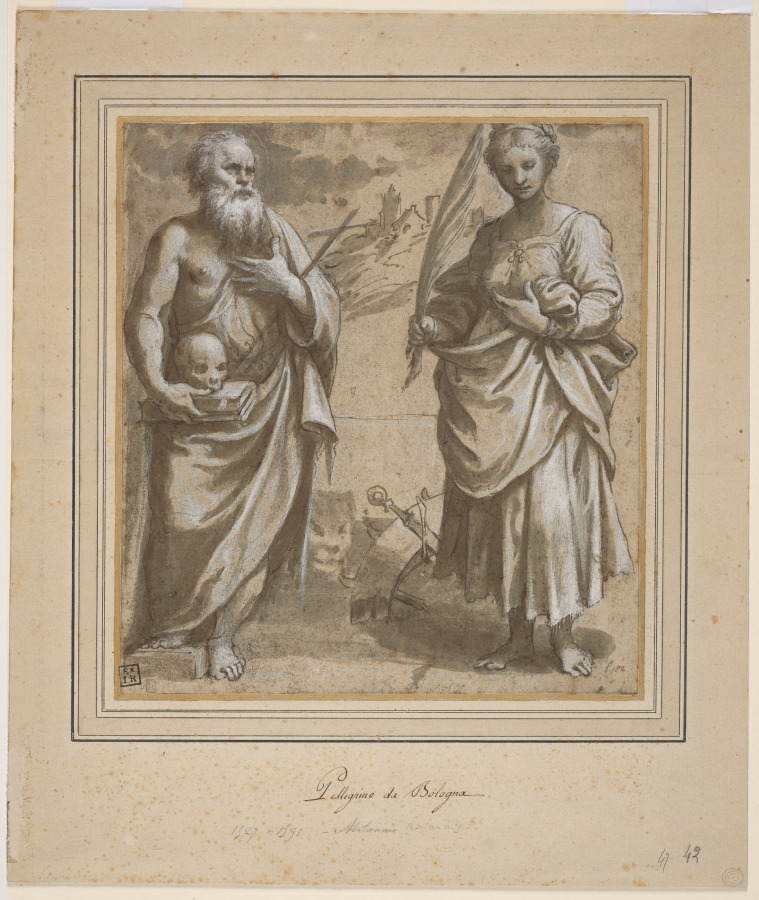
Saint Jerome and Saint Catherine of Alexandria Standing in a Landscape (c. 1530) is in the Cleveland Museum of Art collection. The museum's creator attribution is Girolamo da Treviso the Younger (Italian, 1497–1544).
The work and its context
The museum's open-access catalogue describes the work:
Girolamo da Treviso the Younger created this drawing as a preparatory design for a painting while working in Bologna at the Church of Santissimo Salvatore. The type of composition is known as a sacre conversazione (sacred conversation). Invented in Venice, this genre featured saints within expansive landscapes sharing a contemplative presence. Saint Jerome’s attribute, a lion, is loosely sketched with brush and ink, while the figures are carefully composed with a mix of ink, ink wash, and white highlights on colored paper, giving them a monumental, sculptural appearance.
Object facts
- Title: Saint Jerome and Saint Catherine of Alexandria Standing in a Landscape
- Date: c. 1530
- Creator attribution: Girolamo da Treviso the Younger (Italian, 1497–1544)
- Culture: Italy
- Type: Drawing
- Technique: pen and ink, gray wash, and white heightening over black chalk on prepared buff colored paper
- Dimensions: Sheet: 24.3 x 22 cm (9 9/16 x 8 11/16 in.)
- Collection: DR - Italian
- Department: Drawings
- Accession number: 2026.11
A detail from the museum
After working in Bologna from 1523 to 1538, the artist was invited to the court of King Henry VIII of England, where he became a military engineer and was killed during the English siege of Boulogne-sur-Mer in 1544.
Collection credit
Severance and Greta Millikin Purchase Fund
View the collection record
See the museum's photographs and full catalogue entry. Catalogue text is reproduced from the Cleveland Museum of Art's open-access data, with HTML formatting removed. This object and its supplied image are designated CC0.
Sources
More in Lifestyle
Keep reading