Saint John the Baptist (c. 1475–85): Art, History and Details
Saint John the Baptist at the Cleveland Museum of Art: c. 1475–85, oil on wood (grisaille). Explore the work's context, creator attribution and collection history.
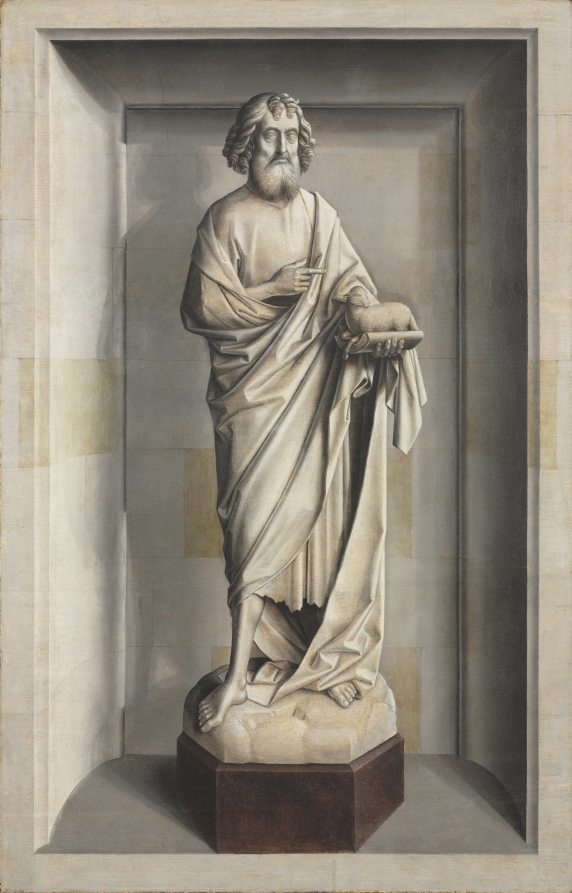
Saint John the Baptist (c. 1475–85) is in the Cleveland Museum of Art collection. The museum's creator attribution is Dieric Bouts (Netherlandish, 1415–1475).
The work and its context
The museum's open-access catalogue describes the work:
This panel once formed part of an altarpiece painted for the Church of Saint Laurentius in Cologne. It originally comprised the reverse of the arrest of Christ, now in the Alte Pinakothek in Munich. Another grisaille panel representing Saint John the Evangelist, also in Munich, formed the exterior of the resurrection. The grisaille technique was a monochromatic method utilizing various shades of gray, often in imitation of sculpture, as is the case here. The illusionistic effect suggests a sculpture not set back in a niche, but clearly separated from it to enhance the three-dimensional appearance. Dieric Bouts was born in Haarlem in Holland, but was mainly active in Leuven in the South Netherlands where he was the city painter from 1468. This painting appears to be the work of a close follower.
Object facts
- Title: Saint John the Baptist
- Date: c. 1475–85
- Creator attribution: Dieric Bouts (Netherlandish, 1415–1475)
- Culture: Netherlands, Leuven, 15th century
- Type: Painting
- Technique: oil on wood (grisaille)
- Dimensions: Framed: 126.1 x 88.3 x 7.6 cm (49 5/8 x 34 3/4 x 3 in.); Unframed: 102.8 x 65.5 cm (40 1/2 x 25 13/16 in.)
- Collection: MED - Medieval Art
- Department: Medieval Art
- Accession number: 1951.354
A detail from the museum
Paintings like this one that are designed to trick the eye are known as trompe-l'œil.
Collection credit
Gift of the Hanna Fund
Further reading listed by the museum
- Francis, Henry. "Two Dutch Fifteenth-Century Panels."The Bulletin of the Cleveland Museum of Art 39, no. 1 (January 1952): 3-6.
- The Cleveland Museum of Art. The Cleveland Museum of Art Handbook. Cleveland, OH: The Cleveland Museum of Art, 1958.
- The Cleveland Museum of Art. Handbook of the Cleveland Museum of Art/1966. Cleveland, OH: The Cleveland Museum of Art, 1966.
View the collection record
See the museum's photographs and full catalogue entry. Catalogue text is reproduced from the Cleveland Museum of Art's open-access data, with HTML formatting removed. This object and its supplied image are designated CC0.
Sources
More in Lifestyle
Keep reading