Sake Bottle with Three Figures (late 1700s): Art, History and Details
Sake Bottle with Three Figures at the Cleveland Museum of Art: late 1700s, porcelain with overglaze enamel and gold decoration (Hizen ware, Arita type). Explore the work's context, creator attribution and collection history.
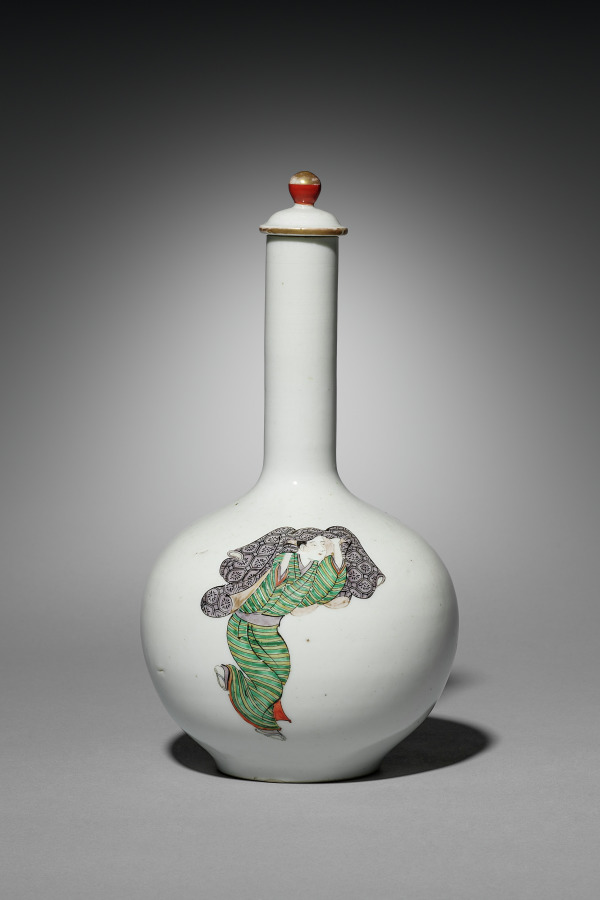
Sake Bottle with Three Figures (late 1700s) is in the Cleveland Museum of Art collection.
The work and its context
The museum's open-access catalogue describes the work:
The bottle features three elegantly drawn figures: a beautiful woman, a young man, and a priest. The artist used a fine-haired brush to draw these figures in colored enamel onto the porcelain bottle, which had already been given a clear glaze. A final firing fused the enamel to the form. The name derives from the port of Imari from where Japanese porcelains were shipped to other cities in Japan, China, and Europe.
Object facts
- Title: Sake Bottle with Three Figures
- Date: late 1700s
- Culture: Japan, Edo period (1615–1868)
- Type: Ceramic
- Technique: porcelain with overglaze enamel and gold decoration (Hizen ware, Arita type)
- Dimensions: Diameter: 14.3 cm (5 5/8 in.); with cover: 27.2 cm (10 11/16 in.); without cover: 24.2 cm (9 1/2 in.)
- Collection: Japanese Art
- Department: Japanese Art
- Accession number: 1964.272
Collection credit
Severance and Greta Millikin Collection
Further reading listed by the museum
- Cleveland Museum of Art, and Jenifer Neils. The World of Ceramics: Masterpieces from the Cleveland Museum of Art. Cleveland: Museum in cooperation with Indiana University Press, 1982.
View the collection record
See the museum's photographs and full catalogue entry. Catalogue text is reproduced from the Cleveland Museum of Art's open-access data, with HTML formatting removed. This object and its supplied image are designated CC0.
Sources
More in Lifestyle
Keep reading
![Title Page of Abbot Berno's "Tonarius:" Initial D[omino] (c.1030; Cleveland 1952.88)](https://openaccess-cdn.clevelandart.org/1952.88/1952.88_web.jpg)