Sakyamuni (1900s): Art, History and Details
Sakyamuni at the Cleveland Museum of Art: 1900s, wood with traces of black lacquer. Explore the work's context, creator attribution and collection history.
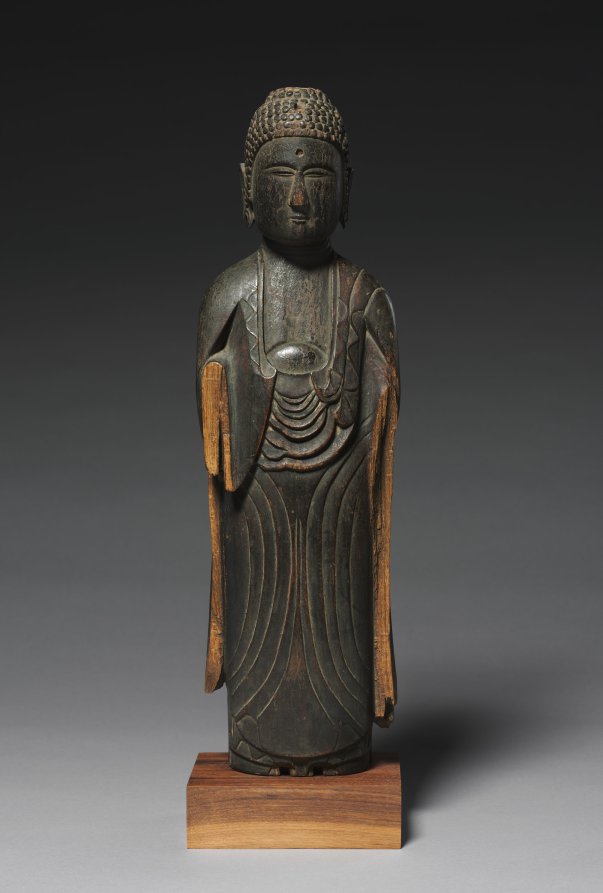
Sakyamuni (1900s) is in the Cleveland Museum of Art collection.
The work and its context
The museum's open-access catalogue describes the work:
This standing Buddhist statue represents Śākyamuni Buddha. Based on its highly formalized carving style and symmetrical drapery, this work is a modern interpretation of ancient Korean Buddhist statues.
Object facts
- Title: Sakyamuni
- Date: 1900s
- Culture: Korea
- Type: Sculpture
- Technique: wood with traces of black lacquer
- Dimensions: Overall: 43.1 cm (16 15/16 in.)
- Collection: Korean Art
- Department: Korean Art
- Accession number: 1988.152
A detail from the museum
Śākyamuni Buddha, the founder of Buddhism, was born in Lumbinī, located in present-day southern Nepal.
Collection credit
John L. Severance Fund
Further reading listed by the museum
- “The Year in Review for 1988.” The Bulletin of the Cleveland Museum of Art 76, no. 2 (1989): 30–75.
View the collection record
See the museum's photographs and full catalogue entry. Catalogue text is reproduced from the Cleveland Museum of Art's open-access data, with HTML formatting removed. This object and its supplied image are designated CC0.
Sources
More in Lifestyle
Keep reading
Related stories
![Qur'an Manuscript Folio (recto) [Right side of Bifolio] (1300s–1400s; Cleveland 1933.473.1.a)](https://openaccess-cdn.clevelandart.org/1933.473.1.a/1933.473.1.a_web.jpg)