Salver (1100s): Art, History and Details
Salver at the Cleveland Museum of Art: 1100s, brass. Explore the work's context, creator attribution and collection history.
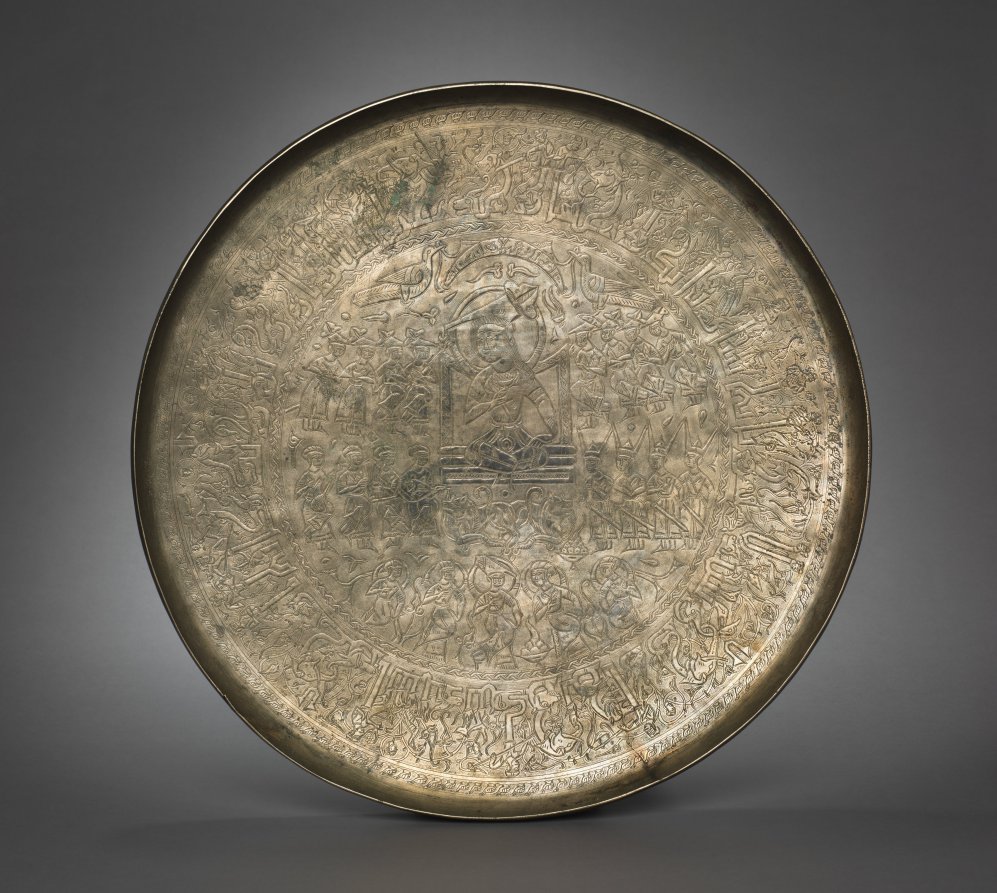
Salver (1100s) is in the Cleveland Museum of Art collection.
The work and its context
The museum's open-access catalogue describes the work:
The central subject is an enthroned ruler surrounded by couriers and musicians. The wide border is filled with an elaborately animated Kufic inscription in which the shafts of the letters terminate in human busts, representing musicians and warriors; various animals; and human hands, holding a variety of symbolic objects. This complex inscription has not yet been deciphered; it appears to be in Persian and to contain only benedictory phrases. Around the outside of the rim, an Arabic inscription, in nashki letters, reads: "You elevated one [of God's] creature[s] and he has ruled with good fortune and blessing and happiness and security and felicity and victory." That the scene does not refer to a specific royal personage but is rather only a representation of the abstract concept of the "Heavenly Banquet" as a symbol of apotheosis indicated by the banner held over the head of the enthroned figure, which actually proclaims this vessel to be "the work of Ibrahim the Decorator [or the Engraver]."
Object facts
- Title: Salver
- Date: 1100s
- Culture: Afghanistan, Ghaznavid Period, 12th Century
- Type: Metalwork
- Technique: brass
- Dimensions: Diameter: 58 cm (22 13/16 in.)
- Collection: Islamic Art
- Department: Islamic Art
- Accession number: 1980.179
A detail from the museum
The distinctively horned hats are seen on other artworks of the Ghaznavid period (977–1186).
Collection credit
John L. Severance Fund
Further reading listed by the museum
- Lee, Sherman E. “The Year in Review for 1980.” The Bulletin of the Cleveland Museum of Art 68, no. 6 (June 1981): 163–219.
- Handbook of the Cleveland Museum of Art. Cleveland, OH: The Museum, 1991.
View the collection record
See the museum's photographs and full catalogue entry. Catalogue text is reproduced from the Cleveland Museum of Art's open-access data, with HTML formatting removed. This object and its supplied image are designated CC0.
Sources
More in Lifestyle
Keep reading