Samite with roundels of rosettes (700s-800s): Art, History and Details
Samite with roundels of rosettes at the Cleveland Museum of Art: 700s-800s, samite: silk. Explore the work's context, creator attribution and collection history.
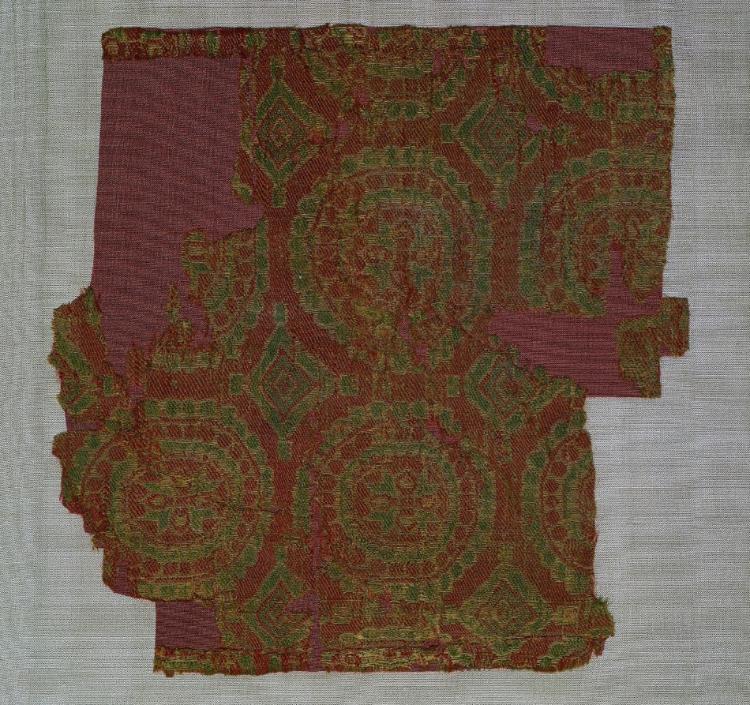
Samite with roundels of rosettes (700s-800s) is in the Cleveland Museum of Art collection.
The work and its context
The museum's open-access catalogue describes the work:
This is one of a large number of silks woven with geometric designs that have traditionally been attributed to Sogdiana. However, the untwisted warps and light weight of the silk indicate that it was woven farther east in Central Asia where Sogdian influence was strong. Similar geometric patterns occur on clothing depicted in paintings found in the Khotan oasis. That region maintained close cultural and economic ties with Sogdiana. Whether this silk was woven in the Khotan oasis or elsewhere in Central Asia is not known.
Object facts
- Title: Samite with roundels of rosettes
- Date: 700s-800s
- Culture: Iran
- Type: Textile
- Technique: samite: silk
- Dimensions: Overall: 17.7 x 17.7 cm (6 15/16 x 6 15/16 in.)
- Collection: Textiles
- Department: Textiles
- Accession number: 1950.514
Collection credit
John L. Severance Fund
Further reading listed by the museum
- Müller-Christensen, Sigrid, Mechthild Flury-Lemberg, and Karen Stolleis. Documenta textilia: Festschrift für Sigrid Müller-Christensen. München: Deutscher Kunstverlag, 1981.
- Shepherd, Dorothy G. 1981. “Zandaniji Revisited.” Documenta Textilia / Hrsg. Von Mechthild Flury-Lemberg Und Karen Stolleis 105-122.
- Watt, James C. Y., Anne E. Wardwell, and Morris Rossabi. When silk was gold: Central Asian and Chinese textiles. 1997.
View the collection record
See the museum's photographs and full catalogue entry. Catalogue text is reproduced from the Cleveland Museum of Art's open-access data, with HTML formatting removed. This object and its supplied image are designated CC0.
Sources
More in Lifestyle
Keep reading