Satyress (c. 1525–28): Art, History and Details
Satyress at the Cleveland Museum of Art: c. 1525–28, bronze. Explore the work's context, creator attribution and collection history.
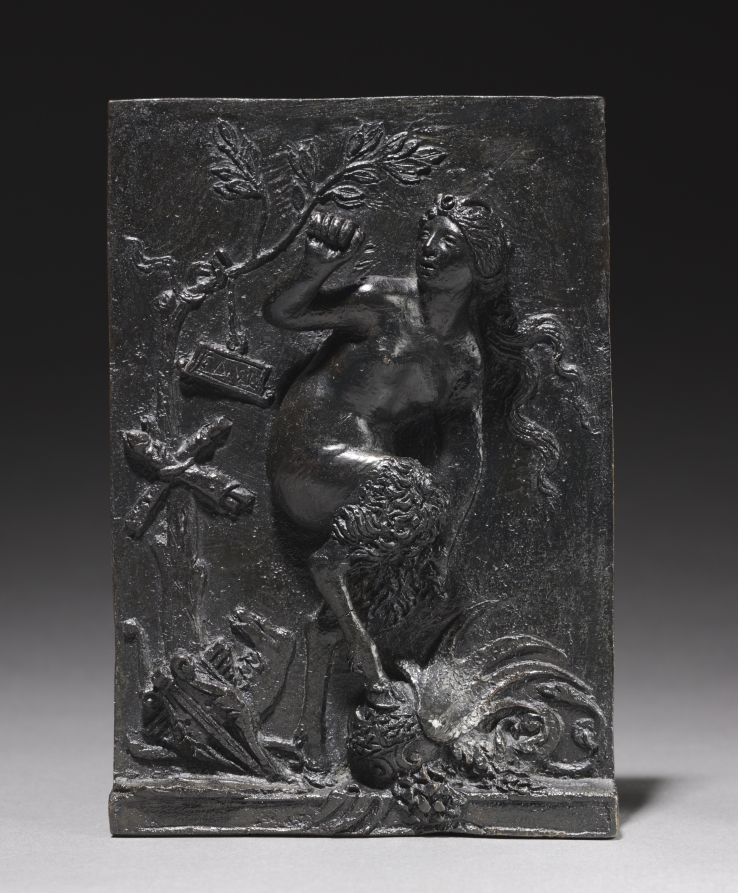
Satyress (c. 1525–28) is in the Cleveland Museum of Art collection. The museum's creator attribution is Giovanni Maria Mosca (Italian, 1495/99–1574).
The work and its context
The museum's open-access catalogue describes the work:
In antiquity, satyrs were lustful woodland deities who delighted in wine and revelry. Renaissance artists adopted them as symbols of vice and carnal love; the female satyr, or satyress, on this bronze plaquette, recently reattributed from Riccio to Mosca, was probably derived from a copper engraving of a Roman sarcophagus by Marcantonio Raimondi (c. 1470/82-1527/34). Both the sarcophagus and subsequent engraving depicted a bacchanalia, or scene of orgiastic carousal; the peculiar objects surrounding the satyress have been added by the artist, possibly in an effort to remove the figure from her lewd original composition and give a more refined meaning. The satyress rests her right hoof upon a plumed helmet. A coiled shape, possibly a snake, winds out of the helmet. To her left, a laurel tree stands with only half of its branches in bloom. Two severed animal legs are tied around its trunk and an illegible plaque hangs from one of its branches. A lyre, a pan pipe, an animal jawbone and a bow are gathered at the base of the tree. The highly allegorical nature of the work uses obscure symbols, rather than a distinct narrative, to convey meaning and could possibly be read as an allegory of physical pleasure overcoming virtue.
Object facts
- Title: Satyress
- Date: c. 1525–28
- Creator attribution: Giovanni Maria Mosca (Italian, 1495/99–1574)
- Culture: Italy
- Type: Sculpture
- Technique: bronze
- Dimensions: Overall: 16.5 x 11.5 cm (6 1/2 x 4 1/2 in.)
- Collection: Sculpture
- Department: European Painting and Sculpture
- Accession number: 1947.29
Collection credit
Gift of Mr. and Mrs. Severance A. Millikin
Further reading listed by the museum
- Milliken, William M. “Italian Renaissance Bronzes.” The Bulletin of the Cleveland Museum of Art 34, no. 4 (April 1947): 64–75.
- Milliken, William. "Paduan Bronzes by Riccio." The Bulletin of the Cleveland Museum of Art 36, no. 3 (March 1949): 33-35.
- The Cleveland Museum of Art. The Cleveland Museum of Art Handbook. Cleveland, OH: The Cleveland Museum of Art, 1958.
View the collection record
See the museum's photographs and full catalogue entry. Catalogue text is reproduced from the Cleveland Museum of Art's open-access data, with HTML formatting removed. This object and its supplied image are designated CC0.
Sources
More in Lifestyle
Keep reading