Scabbard (1700s–1800s): Art, History and Details
Scabbard at the Cleveland Museum of Art: 1700s–1800s, velvet lining with leather straps; wooden scabbard with velvet case and metallic threads. Explore the work's context, creator attribution and collection history.
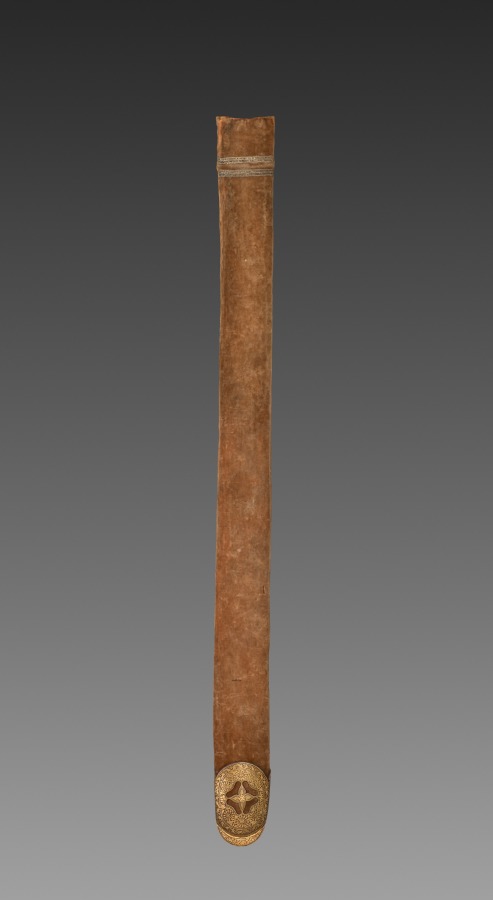
Scabbard (1700s–1800s) is in the Cleveland Museum of Art collection.
The work and its context
The museum's open-access catalogue describes the work:
Straight swords were typical of those used among military and aristocratic circles in the southern regions of the Deccan, in contrast to the curved swords favored by Central Asian equestrians. Increased contact between the Mughal north and the Deccan south during the 1600s led to the appearance of the Deccan-style sword in courtly portraits made during the time of Jahangir and Shah Jahan, and later.
Object facts
- Title: Scabbard
- Date: 1700s–1800s
- Culture: India, perhaps Deccan
- Type: Arms and Armor
- Technique: velvet lining with leather straps; wooden scabbard with velvet case and metallic threads
- Dimensions: Overall: 99 cm (39 in.)
- Collection: Indian Art
- Department: Indian and Southeast Asian Art
- Accession number: 1930.706.b
Collection credit
Gift of S. D. Wright
Further reading listed by the museum
- “Part II. Fifteenth Annual Report of the Cleveland Museum of Art 1930.” The Bulletin of the Cleveland Museum of Art, vol. 18, no. 2, 1931, pp. 1–128.
View the collection record
See the museum's photographs and full catalogue entry. Catalogue text is reproduced from the Cleveland Museum of Art's open-access data, with HTML formatting removed. This object and its supplied image are designated CC0.
Sources
More in Lifestyle
Keep reading


