Scepter (late 1800s or early 1900s): Art, History and Details
Scepter at the Cleveland Museum of Art: late 1800s or early 1900s, Wood, copper alloy, upholstery studs, iron alloy, and cotton. Explore the work's context, creator attribution and collection history.
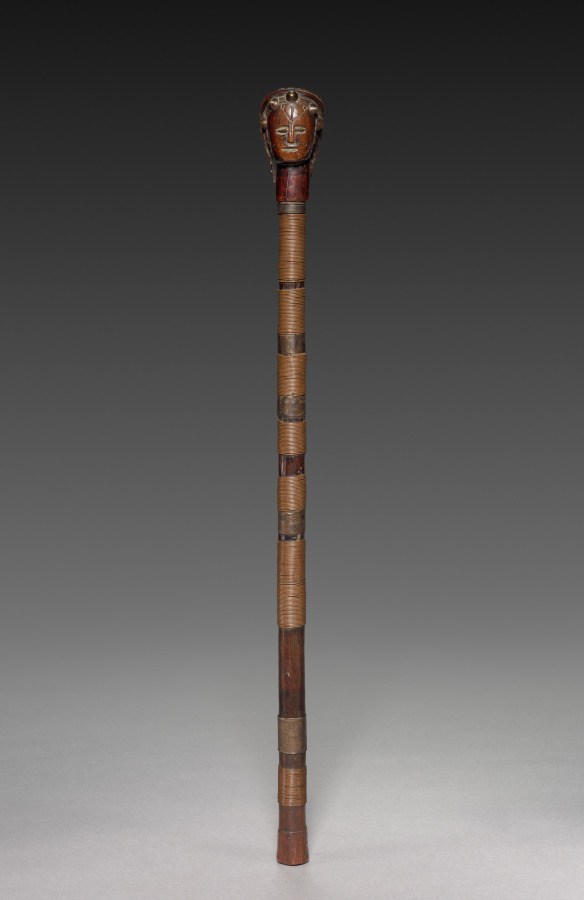
Scepter (late 1800s or early 1900s) is in the Cleveland Museum of Art collection.
The work and its context
The museum's open-access catalogue describes the work:
Staffs and scepters as well as tobacco pipes and mortars are among the most important sculptural creations to stem from the Ovimbundu peoples, a Central African culture. All of these object types have associations with ideas of class, status, and power. This scepter has a handle wrapped in thin copper wire that forms wide bands of alternating metal and wooden passages. Its finial is a human head whose carved headdress or hairstyle is ornamented with round-headed metal tacks.
Object facts
- Title: Scepter
- Date: late 1800s or early 1900s
- Culture: Africa, Central Africa, Angola, Ovimbundu-style maker
- Type: Tools and Equipment
- Technique: Wood, copper alloy, upholstery studs, iron alloy, and cotton
- Dimensions: Overall: 57.5 x 4.5 x 5.5 cm (22 5/8 x 1 3/4 x 2 3/16 in.)
- Collection: African Art
- Department: African Art
- Accession number: 2015.155
Collection credit
Gift of Dr. Anita J. Glaze
View the collection record
See the museum's photographs and full catalogue entry. Catalogue text is reproduced from the Cleveland Museum of Art's open-access data, with HTML formatting removed. This object and its supplied image are designated CC0.
Sources
More in Lifestyle
Keep reading