Sculptural Element from a Reliquary Ensemble (mbulu ngulu) (probably 1800s): Art, History and Details
Sculptural Element from a Reliquary Ensemble (mbulu ngulu) at the Cleveland Museum of Art: probably 1800s, Wood, copper alloy, and iron. Explore the work's context, creator attribution and collection history.
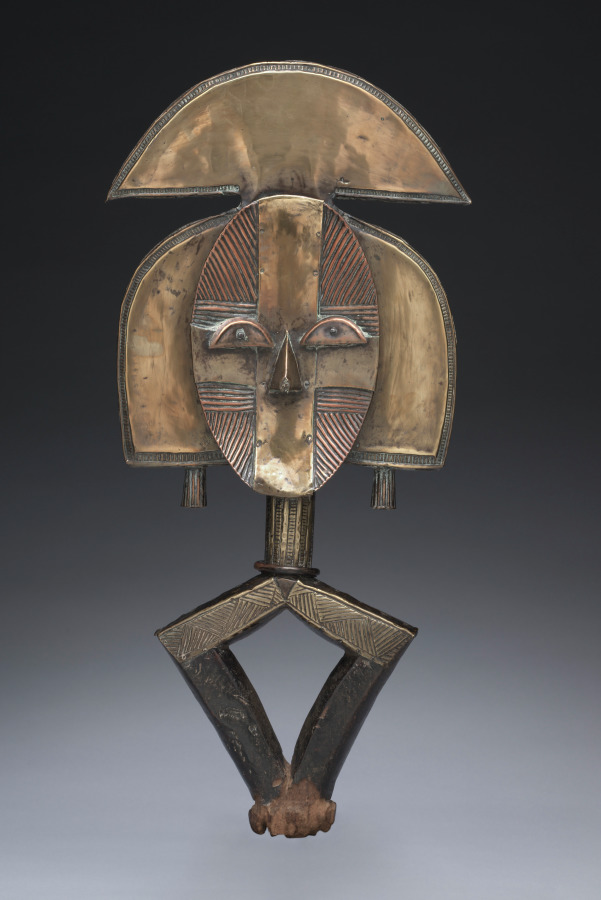
Sculptural Element from a Reliquary Ensemble (mbulu ngulu) (probably 1800s) is in the Cleveland Museum of Art collection.
The work and its context
The museum's open-access catalogue describes the work:
The ethnic map of eastern Gabon is extremely complicated as a result of continuous migratory movements since the 17th century. Kota is the name of one of three culturally closely related people. All share the tradition of commemorating and honoring ancestors through the preservation and worship of sacred ancestral relics within cylindrical bark containers or bound in fiber packets. Covered with sheets of copper and brass, this abstract wooden human-shaped figure—distilled to a planar surface—served as a guardian set atop a basket container holding the skull, certain bones, and other relics of a deceased man. It belonged to a religious institution that honored the memory of individuals who made major contributions during their lifetime. The luminosity of the copper and brass covering was considered intimidating and spiritually empowered to deflect harm and thus protect the owner and his family.
Object facts
- Title: Sculptural Element from a Reliquary Ensemble (mbulu ngulu)
- Date: probably 1800s
- Culture: Africa, Central Africa, Gabon, Kota-style maker
- Type: Sculpture
- Technique: Wood, copper alloy, and iron
- Dimensions: Overall: 61 x 27.5 x 3 cm (24 x 10 13/16 x 1 3/16 in.)
- Collection: African Art
- Department: African Art
- Accession number: 2005.2
A detail from the museum
The diamond-shaped "body" of this sculpture was originally pushed into a container of ancestral relics (bones) up to its "shoulders." Metal covers only areas of the wood that were left visible.
Collection credit
Purchase from the J. H. Wade Fund
Further reading listed by the museum
- Debbaut, Jan, Dominique Favart, G. van Geertruyen, and Palais des beaux-arts (Brussels, Belgium). 1988. Utotombo : L’art D’afrique Noire Dans Les Collections Privées Belges : Société Des Expositions Du Palais Des Beaux-Arts, Bruxelles, 25 Mars-5 Juin 1988 Ed. française ed. Bruxelles: Palais des beaux-arts, Illustration of piece on p. 90, catalogue entry on p. 293-4.
- Petridis, Constantine. "New Acquisitions of African Art at the Cleveland Museum of Art". African Arts. (44) No. 1, Spring 2011. Pg. 54; 58-59, Fig. 6.
- Franklin, David, C. Griffith Mann, and Cleveland Museum of Art. 2012. Treasures from the Cleveland Museum of Art. Cleveland, Ohio: Cleveland Museum of Art, p. 236-7.
View the collection record
See the museum's photographs and full catalogue entry. Catalogue text is reproduced from the Cleveland Museum of Art's open-access data, with HTML formatting removed. This object and its supplied image are designated CC0.
Sources
More in Lifestyle
Keep reading