Seated Manjusri (1700s): Art, History and Details
Seated Manjusri at the Cleveland Museum of Art: 1700s, hanging scroll; ink and color on silk. Explore the work's context, creator attribution and collection history.
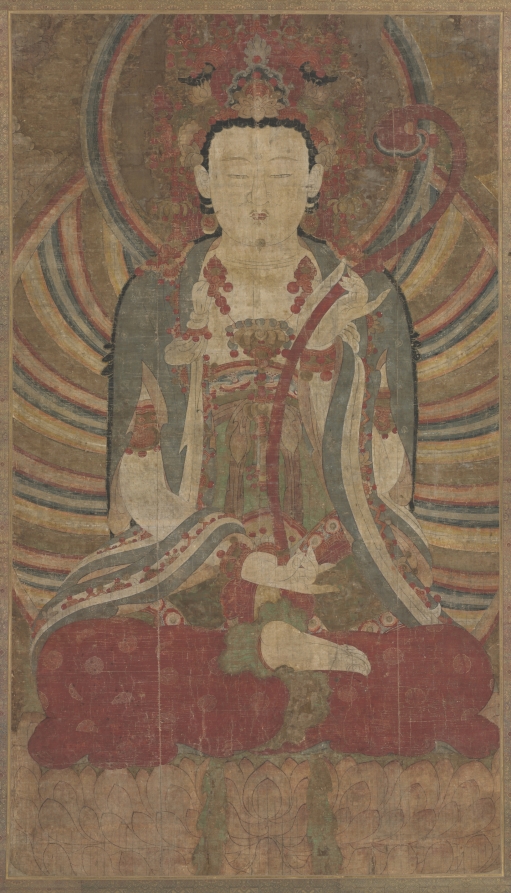
Seated Manjusri (1700s) is in the Cleveland Museum of Art collection.
The work and its context
The museum's open-access catalogue describes the work:
Large-size Buddhist paintings dated to the Joseon period (1392–1910) were once hung behind Buddhist statues, attached to the wall. In the Buddhist pantheon of the Joseon period, Bodhisattva Manjusri appears as a deity attendant to Vairocana Buddha.
Object facts
- Title: Seated Manjusri
- Date: 1700s
- Culture: Korea, Joseon dynasty (1392–1910)
- Type: Painting
- Technique: hanging scroll; ink and color on silk
- Dimensions: Overall: 254.9 x 1146 cm (100 3/8 x 451 3/16 in.)
- Collection: ASIAN - Hanging scroll
- Department: Korean Art
- Accession number: 1919.1020
A detail from the museum
Bodhisattva Manjusri is holding a ruyi scepter to represent ultimate wisdom.
Collection credit
Gift of the John Huntington Art and Polytechnic Trust
Further reading listed by the museum
- MacClean, J. Arthur. “A Korean Buddhist Painting of the Korai Dynasty.” The Bulletin of the Cleveland Museum of Art 6, no. 4 (May 1919): 70.
- The Cleveland Museum of Art. The Cleveland Museum of Art Handbook. Cleveland, OH: The Cleveland Museum of Art, 1958.
- Hwang, Kyu-seong. “A Study on Iconography of Three World Buddhas in the Joseon Dynasty [朝鮮時代 三世佛 圖像에 關한 硏究].” Misul sahak (2006): 221–281.
View the collection record
See the museum's photographs and full catalogue entry. Catalogue text is reproduced from the Cleveland Museum of Art's open-access data, with HTML formatting removed. This object and its supplied image are designated CC0.
Sources
More in Lifestyle
Keep reading