Second Tier for a Flower Pyramid (c. 1690): Art, History and Details
Second Tier for a Flower Pyramid at the Cleveland Museum of Art: c. 1690, Tin-glazed earthenware, painted in blue. Explore the work's context, creator attribution and collection history.
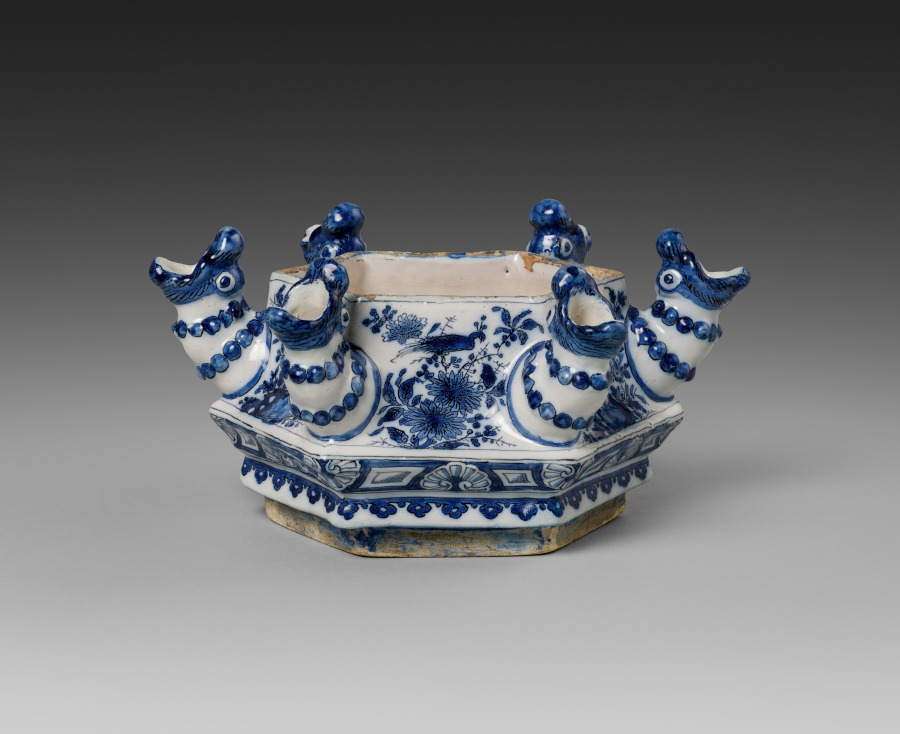
Second Tier for a Flower Pyramid (c. 1690) is in the Cleveland Museum of Art collection. The museum's creator attribution is Adrianus Kocx (Dutch, active 1686–1701); De Grieksche A (The Greek A) Factory (Netherlands, 1658–1811).
The work and its context
The museum's open-access catalogue describes the work:
Allegorical figures representing Faith, Hope, and Love decorate the base of this pyramid, on which rest six tiers with spouts where flowers can be placed. Flower pyramids are among the most complex and luxurious types of ceramics produced in Delft in the late 1600s. This example was made in the Greek A Factory, owned by Adrianus Kocx. During his tenure, the factory became the most prestigious of Delft potteries and received commissions from Queen Mary II, who ruled over England, Scotland, and Ireland together with her husband, William III. She contributed to the international spread of the fashion for Delft ceramics.
Object facts
- Title: Second Tier for a Flower Pyramid
- Date: c. 1690
- Creator attribution: Adrianus Kocx (Dutch, active 1686–1701); De Grieksche A (The Greek A) Factory (Netherlands, 1658–1811)
- Culture: Netherlands, Holland, Delft
- Type: Ceramic
- Technique: Tin-glazed earthenware, painted in blue
- Dimensions: Overall: 13 x 26.3 x 26.3 cm (5 1/8 x 10 3/8 x 10 3/8 in.)
- Collection: Decorative Arts
- Department: Decorative Art and Design
- Accession number: 2024.27.c
A detail from the museum
The iconic blue-and-white ceramics from Delft originated as an attempt to copy Chinese porcelain.
Collection credit
Severance and Greta Millikin Purchase Fund
Further reading listed by the museum
- C. Hussey, "Reddish House, Broad Chalke, Wilts. The Home of Mr. Cecil Beaton – II", Country Life Magazine, March 28, 1957.
View the collection record
See the museum's photographs and full catalogue entry. Catalogue text is reproduced from the Cleveland Museum of Art's open-access data, with HTML formatting removed. This object and its supplied image are designated CC0.
Sources
More in Lifestyle
Keep reading