Section of a Coping Rail (c. 150 BCE): Art, History and Details
Section of a Coping Rail at the Cleveland Museum of Art: c. 150 BCE, sandstone. Explore the work's context, creator attribution and collection history.
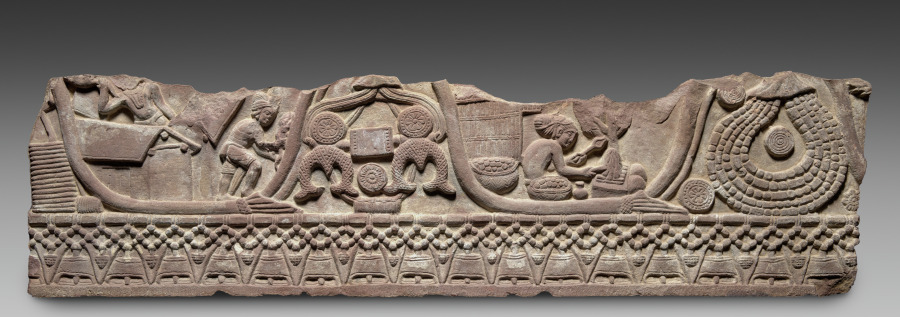
Section of a Coping Rail (c. 150 BCE) is in the Cleveland Museum of Art collection.
The work and its context
The museum's open-access catalogue describes the work:
A coping rail is the top portion of a fence that connects the upright posts. Here, an undulating lotus rhizome blossoms with jewelry, and in the spaces between are scenes from two of the Buddha's past lives. At the left, a man catches and kills a lizard to eat it, and then lies about its running off (Godha Jataka); at the right an ascetic performs a Vedic fire sacrifice (possibly the Rajovada Jataka).
Object facts
- Title: Section of a Coping Rail
- Date: c. 150 BCE
- Culture: India, Madhya Pradesh, Bharhut, Shunga period
- Type: Sculpture
- Technique: sandstone
- Dimensions: Overall: 30.5 x 122 cm (12 x 48 1/16 in.)
- Collection: Indian Art - Sunga, Bharhut
- Department: Indian and Southeast Asian Art
- Accession number: 1972.366
A detail from the museum
Known for having excellent vertical climbing abilities, the Indian monitor lizard (godha) is prized for its skin and meat.
Collection credit
Gift of Mr. and Mrs. Severance A. Millikin
Further reading listed by the museum
- Lee, Sherman E. "The Year in Review for 1972." The Bulletin of the Cleveland Museum of Art 60, no. 3 (1973): 63-115.
- The Cleveland Museum of Art. Handbook of the Cleveland Museum of Art/1978. Cleveland, OH: The Cleveland Museum of Art, 1978.
- The Cleveland Museum of Art. Handbook of the Cleveland Museum of Art. Cleveland, OH: The Cleveland Museum of Art, 1991.
View the collection record
See the museum's photographs and full catalogue entry. Catalogue text is reproduced from the Cleveland Museum of Art's open-access data, with HTML formatting removed. This object and its supplied image are designated CC0.
Sources
More in Lifestyle
Keep reading