Segmentum from a Tunic (750–99): Art, History and Details
Segmentum from a Tunic at the Cleveland Museum of Art: 750–99, tapestry; linen and wool. Explore the work's context, creator attribution and collection history.
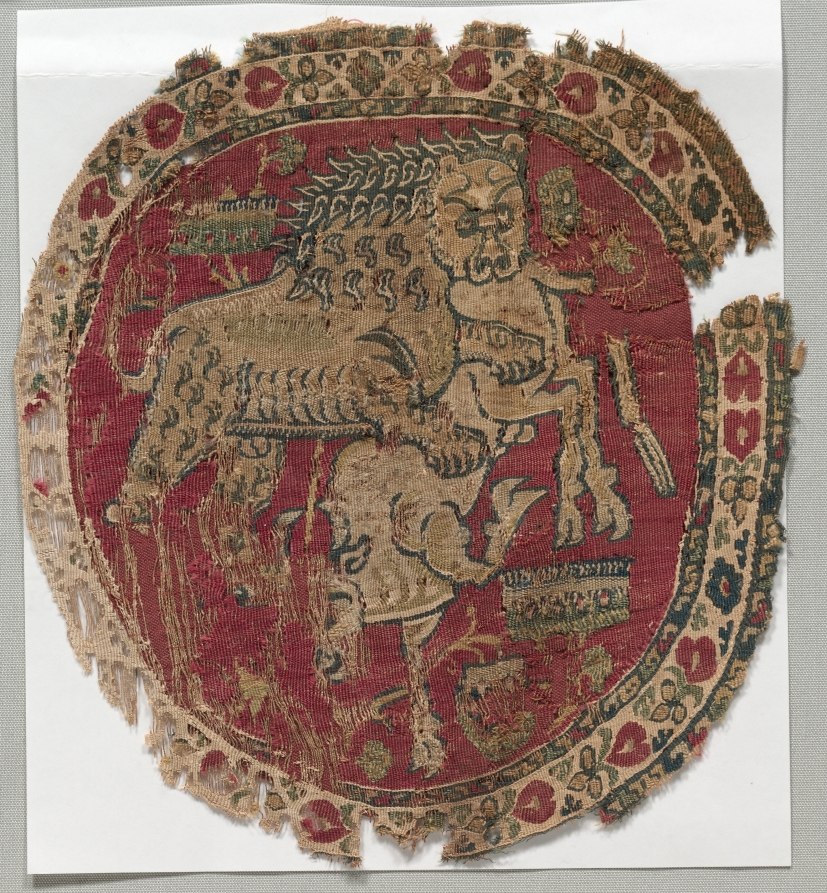
Segmentum from a Tunic (750–99) is in the Cleveland Museum of Art collection.
The work and its context
The museum's open-access catalogue describes the work:
A fierce lion with a pronounced mane takes down a large bull on a purple red ground with stylized trees and plants. Both animals appear to be facing us, the viewer. The border displays a formal wreath of rosettes. This roundel, or circular element, and two additional matching examples suggest that they originally decorated the front and back of a tunic. The scene may be an abbreviated reference to the royal hunt, one of the pleasures of the court that served as propaganda to legitimize the authority of rulers by confirming their ability to control natural resources.
Object facts
- Title: Segmentum from a Tunic
- Date: 750–99
- Culture: Egypt, Abbasid period
- Type: Textile
- Technique: tapestry; linen and wool
- Dimensions: Overall: 23.5 x 20.4 cm (9 1/4 x 8 1/16 in.)
- Collection: T - Islamic
- Department: Textiles
- Accession number: 1969.38
A detail from the museum
The animal battle takes place on a background formed by the spreading branches of a tree with stylized flowers and leaves.
Collection credit
The A. W. Ellenberger, Sr., Endowment Fund
Further reading listed by the museum
- “Annual Report for 1969.” The Bulletin of the Cleveland Museum of Art 57, no. 6 (February 1970): 163–193.
- The Cleveland Museum of Art. Handbook of the Cleveland Museum of Art/1978. Cleveland, OH: The Cleveland Museum of Art, 1978.
- Bornstein, Christine Verzár, and Priscilla Parsons Soucek. The Meeting of Two Worlds: The Crusades and the Mediterranean Context : [Exhibition], the University of Michigan Museum of Art, May 9-September 27, 1981. Ann Arbor: The Museum, 1981.
View the collection record
See the museum's photographs and full catalogue entry. Catalogue text is reproduced from the Cleveland Museum of Art's open-access data, with HTML formatting removed. This object and its supplied image are designated CC0.
Sources
More in Lifestyle
Keep reading
Related stories