Self-Portrait (1802): Art, History and Details
Self-Portrait at the Cleveland Museum of Art: 1802, watercolor on ivory in a gold frame. Explore the work's context, creator attribution and collection history.
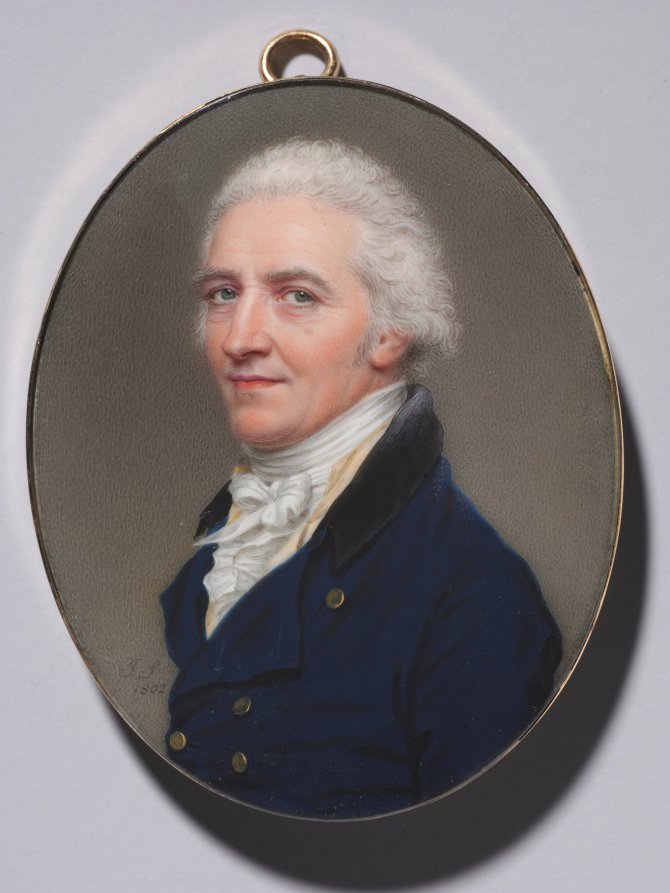
Self-Portrait (1802) is in the Cleveland Museum of Art collection. The museum's creator attribution is John I Smart (British, 1741–1811).
The work and its context
The museum's open-access catalogue describes the work:
This self-portrait depicts the artist’s almost full face with blue-gray eyes; gray, curly hair and sideburns; and a ruddy complexion. In spite of the fact that it was no longer in fashion, the powder on his collar indicates that even in 1802 John Smart continued to powder his hair. He wears a dark blue coat with brass buttons; white stock collar, bow, and frill; and deep yellow waistcoat. Arthur Jaffé has argued that the yellow waistcoat also seen in Smart’s portrait in the National Gallery, London, indicates his Whiggish political proclivities. The background of the miniature is yellowish gray, and it is signed at the lower left: “JS / 1802.” The silver-gilt frame is probably original, but the gold monogram JS, placed over an opalescent background, may have been added later. The portrait was formerly in the collection of William Henry Bose, who was Smart’s great-grandson. The Bose collection of Smart sketches and preparatory studies was sold February 15, 1937, at Christie’s, London, but the self-portrait was retained and lent to the Victoria and Albert Museum. In her biography of Smart, Daphne Foskett notes that in 1913 William Bose received a letter from the Reynolds Galleries in London informing him that “Smart’s miniatures were not then selling quite as well as they formerly did, and that the average price of a male portrait was from £20 to £30 and for a lady, young and good-looking, from £30 to £70.” In 1947, over three decades later, the market had revived, and the self-portrait sold for £360. In her Dictionary of British Miniature Painters, Foskett notes that Smart painted nine self-portraits, but she does not list them. Having executed at least nine self-portraits during two decades of his mature career, Smart seemed more invested in recording his changing likeness than most of his miniature-painting contemporaries. This attitude of consistent introspection and careful attention to the conservation of his skills outside of the pressures of a commission is in keeping with his practice of executing and retaining highly finished preliminary studies of his sitters for their portraits. In each of his self-portraits, Smart is conservatively dressed and coiffed, with the ruddy complexion and slightly amused expression found in so many of the portraits he painted. Portraits of Smart by other artists reiterate both the humor and intensity seen in the self-portraits.
Object facts
- Title: Self-Portrait
- Date: 1802
- Creator attribution: John I Smart (British, 1741–1811)
- Culture: England, early 19th Century
- Type: Portrait Miniature
- Technique: watercolor on ivory in a gold frame
- Dimensions: Framed: 7 x 5.7 cm (2 3/4 x 2 1/4 in.); Unframed: 6.9 x 5.4 cm (2 11/16 x 2 1/8 in.)
- Collection: Mod Euro - Painting 1800-1960
- Department: Modern European Painting and Sculpture
- Accession number: 1952.95
A detail from the museum
John Smart signed this self-portrait with his initials in the lower left along with the date it was made, 1802.
Collection credit
The Edward B. Greene Collection
Further reading listed by the museum
- Christie, Manson & Woods. Miniatures, Objects of Art and Vertu. 1945.
- Sotheby's (Firm). Fine Portrait Miniatures, Enamels and Snuff Boxes. 1947.
- Cleveland Museum of Art, and Edward Belden Greene. Portrait Miniatures ; The Edward B. Greene Collection. 1951.
View the collection record
See the museum's photographs and full catalogue entry. Catalogue text is reproduced from the Cleveland Museum of Art's open-access data, with HTML formatting removed. This object and its supplied image are designated CC0.
Sources
More in Lifestyle
Keep reading