Seven Heroes or Warriors Killing Abhimanya, Son of Arjuna (c. 1890): Art, History and Details
Seven Heroes or Warriors Killing Abhimanya, Son of Arjuna at the Cleveland Museum of Art: c. 1890, Gum tempera, graphite, ink, and tin on paper. Explore the work's context, creator attribution and collection history.
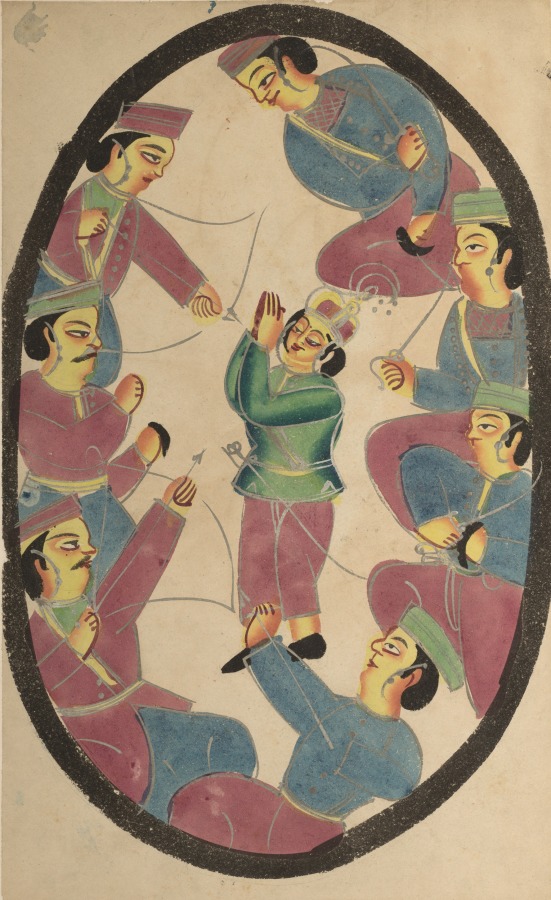
Seven Heroes or Warriors Killing Abhimanya, Son of Arjuna (c. 1890) is in the Cleveland Museum of Art collection.
The work and its context
The museum's open-access catalogue describes the work:
Abhimanyu (son of Arjuna and Subhadra, nephew of Krishna) is a tragic figure from the epic Mahabharata (The Great History of the Descendants of Bharat). As a fetus in his mother’s womb he hears how to penetrate the Chakravyuha, a circular pattern of troops, from his father Arjuna who is talking with his mother Subhadra. Noticing that Subhadra is asleep, Arjuna stops speaking and does not explain to her how to escape after attacking it. Abhimanyu thus only has partial knowledge. Here he is depicted as surrounded in the Chakravyuha and about to be killed.
Object facts
- Title: Seven Heroes or Warriors Killing Abhimanya, Son of Arjuna
- Date: c. 1890
- Culture: Eastern India, Bengal, Kolkata, Kalighat
- Type: Painting
- Technique: Gum tempera, graphite, ink, and tin on paper
- Dimensions: Secondary Support: 49.9 x 30 cm (19 5/8 x 11 13/16 in.); Painting only: 45.6 x 27.7 cm (17 15/16 x 10 7/8 in.)
- Collection: Indian Art
- Department: Indian and Southeast Asian Art
- Accession number: 2003.144
Collection credit
Gift of William E. Ward in memory of his wife, Evelyn Svec Ward
View the collection record
See the museum's photographs and full catalogue entry. Catalogue text is reproduced from the Cleveland Museum of Art's open-access data, with HTML formatting removed. This object and its supplied image are designated CC0.
Sources
More in Lifestyle
Keep reading