Seven Jeweled Mountain (late 1800s): Art, History and Details
Seven Jeweled Mountain at the Cleveland Museum of Art: late 1800s, ten-panel screen; ink and color on silk. Explore the work's context, creator attribution and collection history.
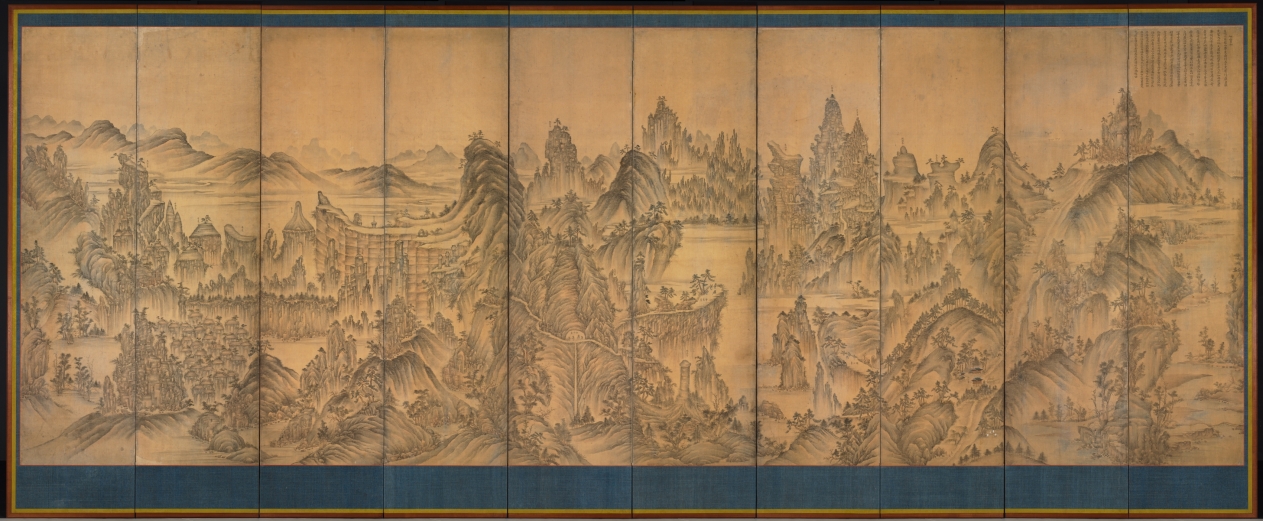
Seven Jeweled Mountain (late 1800s) is in the Cleveland Museum of Art collection.
The work and its context
The museum's open-access catalogue describes the work:
With a bird’s-eye view, this ten-panel folding screen portrays the famous Seven Jeweled Mountain 칠보산 in North Korea. Ancient volcanic eruptions shaped the mountain’s unique and awe-inspiring terrain such as phallic-shaped pillars (panel #5, from the right); a large flat-topped, steep-sided cliff (panels #7 and #8), and a rugged mountain composed of metamorphic and igneous rocks (panels #9 and #10). The tradition of landscape painting that details actual natural sites and captures their topographic features in Korea began in the 1700s and continued onward. While such natural wonders were beloved as popular destinations for tourism and pilgrimage, after the Korean War (1950–53), these sites in North Korea are no longer accessible to the outside world. This folding screen detailing the mountain’s distinctive topography feeds our imagination and longing for such an unattainable place.
Object facts
- Title: Seven Jeweled Mountain
- Date: late 1800s
- Culture: Korea, Joseon dynasty (1392–1910)
- Type: Painting
- Technique: ten-panel screen; ink and color on silk
- Dimensions: Overall: 185.2 x 42.9 cm (72 15/16 x 16 7/8 in.); Each screen: 158.2 x 42.9 cm (62 5/16 x 16 7/8 in.)
- Collection: ASIAN - Folding screen
- Department: Korean Art
- Accession number: 1989.6
A detail from the museum
Featuring a spectacular panoramic view and topographical details, this ten-panel folding screen is an excellent 19th-century version of the Korean “true-view” landscape painting tradition.
Collection credit
Mr. and Mrs. William H. Marlatt Fund
Further reading listed by the museum
- Turner, Evan H. “The Year in Review: Selections 1989.” The Bulletin of the Cleveland Museum of Art 77, no. 2 (February 1990): 38–78.
- Cunningham, Michael R. "Notable Acquisitions." The Bulletin of the Cleveland Museum of Art 78, no. 3 (June 1991): 63–147.
- Yi, Seongmi, "Artistic Tradition and the Depiction of Reality: True-View Landscape Painting of the Choosŏn Dynasty." Arts of Korea. New York: Metropolitan Museum of Art, 1998: 330–468.
View the collection record
See the museum's photographs and full catalogue entry. Catalogue text is reproduced from the Cleveland Museum of Art's open-access data, with HTML formatting removed. This object and its supplied image are designated CC0.
Sources
More in Lifestyle
Keep reading