Shakyamuni Emerging from the Mountains (1244): Art, History and Details
Shakyamuni Emerging from the Mountains at the Cleveland Museum of Art: 1244, hanging scroll; ink on paper. Explore the work's context, creator attribution and collection history.
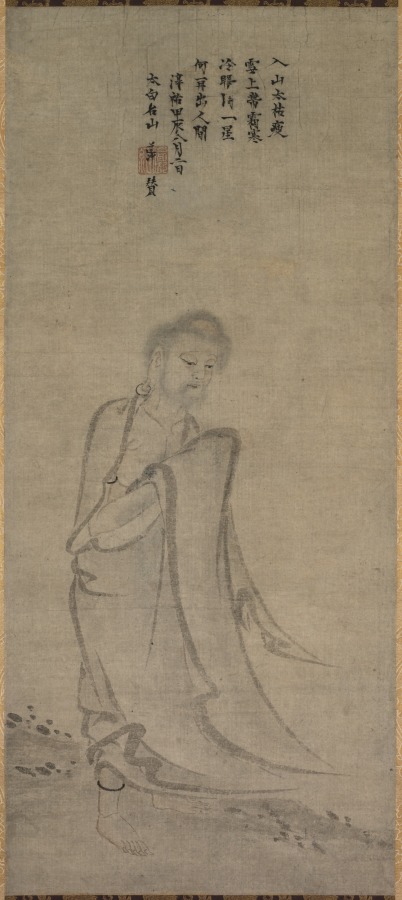
Shakyamuni Emerging from the Mountains (1244) is in the Cleveland Museum of Art collection.
The work and its context
The museum's open-access catalogue describes the work:
Shakyamuni emerged from the mountains after years of ascetic practices, which anticipated his sermon in Deer Park and attainment of enlightenment under the bodhi tree. However, this figure of Shakyamuni can be interpreted as having already achieved enlightenment and reentered the earthly world to spread the dharma (Buddhist law). Chijue Daoching’s inscription mentions his indifferent glance at the morning star, suggesting nonattachment: Entering the mountains he was much too thin and withered. The snow is overlaid with frost—it is cold. Casting an indifferent glance, he saw a [morning] star. Why should he once again emerge among the world of men.
Object facts
- Title: Shakyamuni Emerging from the Mountains
- Date: 1244
- Culture: China, Southern Song dynasty (1127–1279)
- Type: Painting
- Technique: hanging scroll; ink on paper
- Dimensions: Painting: 70.7 x 30.3 cm (27 13/16 x 11 15/16 in.); Overall with knobs: 166.4 x 49.9 cm (65 1/2 x 19 5/8 in.)
- Collection: ASIAN - Hanging scroll
- Department: Chinese Art
- Accession number: 1970.2
A detail from the museum
The painting was inscribed by the abbot of Jingde Temple 景德寺 of Mount Tiantong 天童山 near Ningbo 寧波.
Collection credit
John L. Severance Fund
Further reading listed by the museum
- "New Oriental art galleries at Cleveland." Apollo: A Journal of the Arts. August 1970, Vol. 92, pp. 148-151.
- Lee, Sherman E. “Zen in Art: Art in Zen.” The Bulletin of the Cleveland Museum of Art 59, no. 9 (November 1972): 238–259.
- Lee, Sherman Emery, and James Robinson. The Colors of Ink: Chinese Paintings and Related Ceramics from the Cleveland Museum of Art. New York: Asia Society; distributed by New York Graphic Society, 1974.
View the collection record
See the museum's photographs and full catalogue entry. Catalogue text is reproduced from the Cleveland Museum of Art's open-access data, with HTML formatting removed. This object and its supplied image are designated CC0.
Sources
More in Lifestyle
Keep reading