Shakyamuni with the Sixteen Benevolent Deities (mid- to late 1300s): Art, History and Details
Shakyamuni with the Sixteen Benevolent Deities at the Cleveland Museum of Art: mid- to late 1300s, Hanging scroll; ink, color, gold and cut gold on silk. Explore the work's context, creator attribution and collection history.
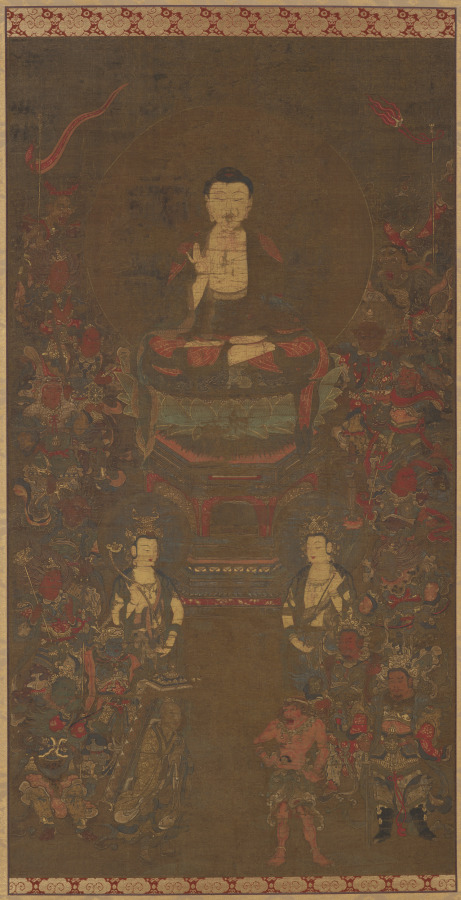
Shakyamuni with the Sixteen Benevolent Deities (mid- to late 1300s) is in the Cleveland Museum of Art collection.
The work and its context
The museum's open-access catalogue describes the work:
The historical Buddha Shakyamuni forms a triad with the bodhisattvas Fugen and Monju. Sixteen deities who protect the Buddhist scripture called the Great Perfection of Wisdom Sutra surround them. At the bottom left stands the Chinese monk Xuanzang, noted as a Buddhist scholar and translator of religious texts from India, including the Great Wisdom Sutra.
Object facts
- Title: Shakyamuni with the Sixteen Benevolent Deities
- Date: mid- to late 1300s
- Culture: Japan, Nanbokuchō period (1336–92)
- Type: Painting
- Technique: Hanging scroll; ink, color, gold and cut gold on silk
- Dimensions: Painting: 106.5 x 56.6 cm (41 15/16 x 22 5/16 in.); Overall with knobs and cord: 201.5 x 80.4 cm (79 5/16 x 31 5/8 in.)
- Collection: ASIAN - Hanging scroll
- Department: Japanese Art
- Accession number: 1941.279
A detail from the museum
This painting would have been the main icon for ceremonial readings of the Great Perfection of Wisdom Sutra.
Collection credit
Gift of Mrs. Henry S. Upson, 25th Anniversary Gift
Further reading listed by the museum
- Vilbar, Sinéad. “Protecting the Word.” Cleveland Art: Cleveland Museum of Art Members Magazine 61, no. 1 (Winter 2021): 20–21.
View the collection record
See the museum's photographs and full catalogue entry. Catalogue text is reproduced from the Cleveland Museum of Art's open-access data, with HTML formatting removed. This object and its supplied image are designated CC0.
Sources
More in Lifestyle
Keep reading