Shakyamuni with two attendants (1300s): Art, History and Details
Shakyamuni with two attendants at the Cleveland Museum of Art: 1300s, Hanging scroll; ink, color, and gold on silk. Explore the work's context, creator attribution and collection history.
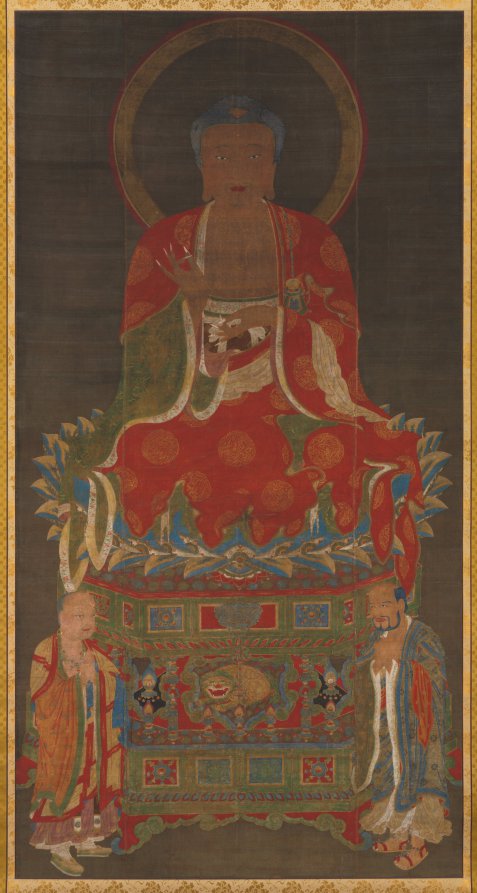
Shakyamuni with two attendants (1300s) is in the Cleveland Museum of Art collection.
The work and its context
The museum's open-access catalogue describes the work:
The historic Buddha Shakyamuni is seated on an elaborately decorated pedestal and flanked by two attendants making gestures of devotion. The unknown artist used gold and deeply hued pigments to depict the luxurious fabrics, particularly the golden medallions of swirling dragons and clouds on the Buddha’s red robe. The painting itself is mounted in a Buddhist style with two tiers of fine silk borders. The inner border of gold brocade on a cream background surrounds the painting. The outer border is yellow silk; decorative silk strips, called futai, dangle from the top hanging bar.
Object facts
- Title: Shakyamuni with two attendants
- Date: 1300s
- Culture: China, Yuan (1271-1368) or early Ming dynasty (1368-1644)
- Type: Painting
- Technique: Hanging scroll; ink, color, and gold on silk
- Dimensions: Overall: 293.5 x 136 cm (115 9/16 x 53 9/16 in.); Painting only: 218.4 x 112.8 cm (86 x 44 7/16 in.); with knobs: 293.5 x 144.2 cm (115 9/16 x 56 3/4 in.)
- Collection: ASIAN - Hanging scroll
- Department: Chinese Art
- Accession number: 1982.25
A detail from the museum
This painting was made on 3 vertical panels of silk stitched together. The joins are visible just outside of Shakyamuni's left and right shoulders.
Collection credit
John L. Severance Fund
Further reading listed by the museum
- Lee, Sherman E. “Year in Review for 1982.” The Bulletin of the Cleveland Museum of Art 70, no. 1 (January 1983): 3–55.
- “Front Matter.” The Bulletin of the Cleveland Museum of Art 70, no. 6 (June 1983).
- Kungnip Chungang Pangmulgwan (Korea). Koryŏ Purhwa taejŏn [고려 불화 대전 = Masterpieces of Goryeo Buddhist painting]. Seoul: National Museum of Korea, 2010.
View the collection record
See the museum's photographs and full catalogue entry. Catalogue text is reproduced from the Cleveland Museum of Art's open-access data, with HTML formatting removed. This object and its supplied image are designated CC0.
Sources
More in Lifestyle
Keep reading