Shamsa (sunburst) with portrait of Aurangzeb (1618–1707), from the Emperor's Album (the Kevorkian Album) (illumination 1640–55; original portrait c. 1640–50; altered after 1658): Art, History and Deta
Shamsa (sunburst) with portrait of Aurangzeb (1618–1707), from the Emperor's Album (the Kevorkian Album) at the Cleveland Museum of Art: illumination 1640–55; original portrait c. 1640–50; altered after 1658, Gum tempera and gold on paper.
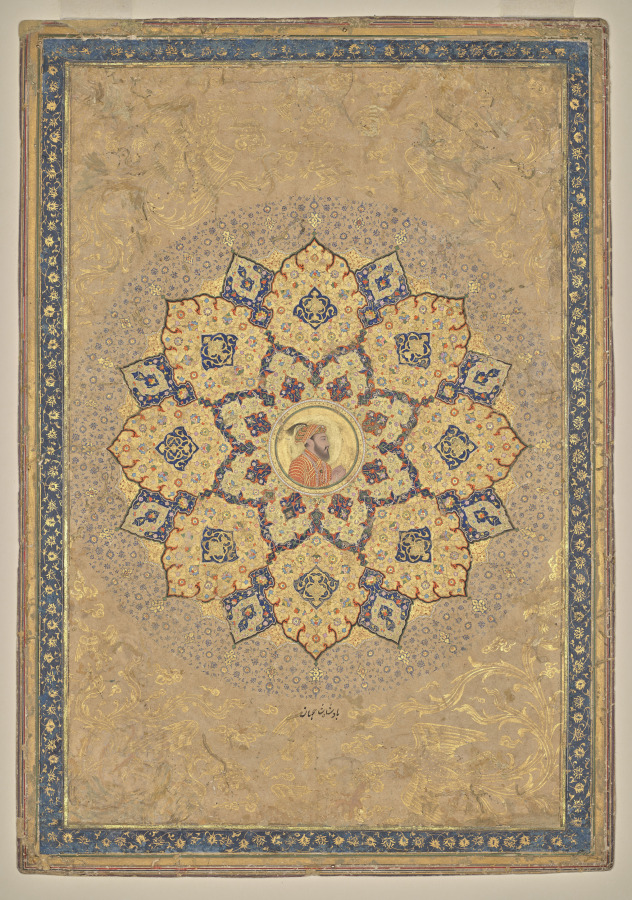
Shamsa (sunburst) with portrait of Aurangzeb (1618–1707), from the Emperor's Album (the Kevorkian Album) (illumination 1640–55; original portrait c. 1640–50; altered after 1658) is in the Cleveland Museum of Art collection. The museum's creator attribution is Bichitr (Indian, active c. 1615–50).
The work and its context
The museum's open-access catalogue describes the work:
This closing page of an imperial Mughal album originally had the shamsa, or sunburst, with a plain gold disc in the center, referencing the light of God as divine sanction for Emperor Shah Jahan’s rule. The depiction of divine light by means of floral and geometric patterns was painted by hand with mathematical precision in gold and lapis lazuli. The portrait of Aurangzeb was probably added when he took over the imperial library after seizing the throne from his father, Shah Jahan, in 1658 and adopting the name Alamgir, which means “Seizer of the Universe.” The string of prayer beads in his right hand points to his extreme religious orthodoxy, which dramatically altered the culture of the Mughal court from what had previously been an openly ecumenical center.
Object facts
- Title: Shamsa (sunburst) with portrait of Aurangzeb (1618–1707), from the Emperor's Album (the Kevorkian Album)
- Date: illumination 1640–55; original portrait c. 1640–50; altered after 1658
- Creator attribution: Bichitr (Indian, active c. 1615–50)
- Culture: India, Mughal court, made for Shah Jahan
- Type: Painting
- Technique: Gum tempera and gold on paper
- Dimensions: Page: 40 x 27.7 cm (15 3/4 x 10 7/8 in.)
- Collection: Indian Art
- Department: Indian and Southeast Asian Art
- Accession number: 2013.331
A detail from the museum
Tooling the gold cloud motif with pinpricks makes it catch more light and shimmer.
Collection credit
Gift in honor of Madeline Neves Clapp; Gift of Mrs. Henry White Cannon by exchange; Bequest of Louise T. Cooper; Leonard C. Hanna Jr. Fund; From the Catherine and Ralph Benkaim Collection
Further reading listed by the museum
- Quintanilla, Sonya Rhie. "2013 Acquisitions: Indian and Southeast Asian Art .” Cleveland Art: Cleveland Museum of Art Members Magazine 54, no. 2 (March/April 2014): 13.
- Mace, Sonya Rhie, Mohsen Ashtiany, Catherine Glynn, Pedro Moura Carvalho, Marcus Fraser, and Ruby Lal. Mughal Paintings: Art and Stories: the Cleveland Museum of Art. London: D Giles Limited, 2016.
View the collection record
See the museum's photographs and full catalogue entry. Catalogue text is reproduced from the Cleveland Museum of Art's open-access data, with HTML formatting removed. This object and its supplied image are designated CC0.
Sources
More in Lifestyle
Keep reading