Shaped horse trapping (1600s): Art, History and Details
Shaped horse trapping at the Cleveland Museum of Art: 1600s, velvet, brocaded and pile warp substitution: silk and gilt-metal thread. Explore the work's context, creator attribution and collection history.
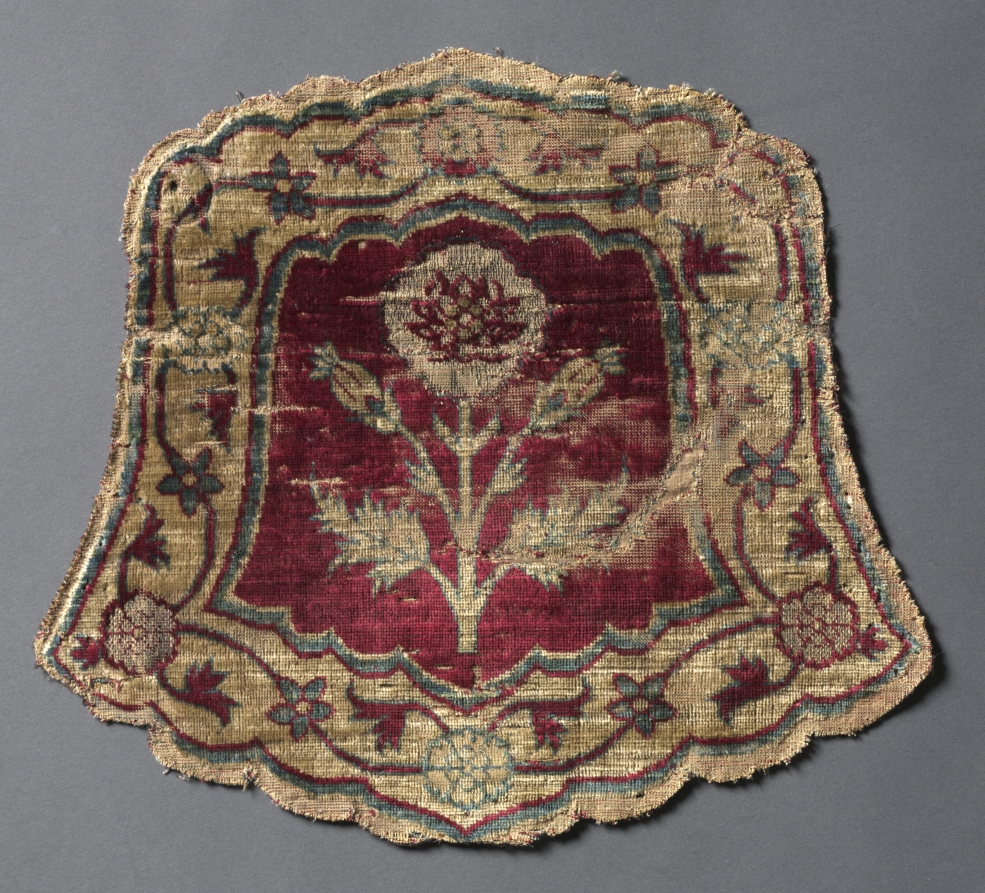
Shaped horse trapping (1600s) is in the Cleveland Museum of Art collection.
The work and its context
The museum's open-access catalogue describes the work:
The scrolling floral vines in the border and the combination of gold with imperial crimson resonate with the painted depiction of the textiles that accompany portraits of the emperor. The poppy plant in the center can be identified by the leaves with multiple lacy points and may reference the opium in which Emperor Jahangir indulged daily.
Object facts
- Title: Shaped horse trapping
- Date: 1600s
- Culture: India
- Type: Velvet
- Technique: velvet, brocaded and pile warp substitution: silk and gilt-metal thread
- Dimensions: Average: 26.1 x 23.5 cm (10 1/4 x 9 1/4 in.)
- Collection: T - Islamic
- Department: Textiles
- Accession number: 1927.376
A detail from the museum
Pile warp substitution was a Persian weaving technique brought to Mughal India by Iranian weavers.
Collection credit
Purchase from the J. H. Wade Fund
Further reading listed by the museum
- Mackie, Louise W. Symbols of Power: Luxury Textiles from Islamic Lands, 7th-21st Century. Cleveland; New Haven: Cleveland Museum of Art; Yale University Press, 2015.
View the collection record
See the museum's photographs and full catalogue entry. Catalogue text is reproduced from the Cleveland Museum of Art's open-access data, with HTML formatting removed. This object and its supplied image are designated CC0.
Sources
More in Lifestyle
Keep reading