Short-necked Storage Jar (300s CE): Art, History and Details
Short-necked Storage Jar at the Cleveland Museum of Art: 300s CE, gray earthenware with impressed cord design. Explore the work's context, creator attribution and collection history.
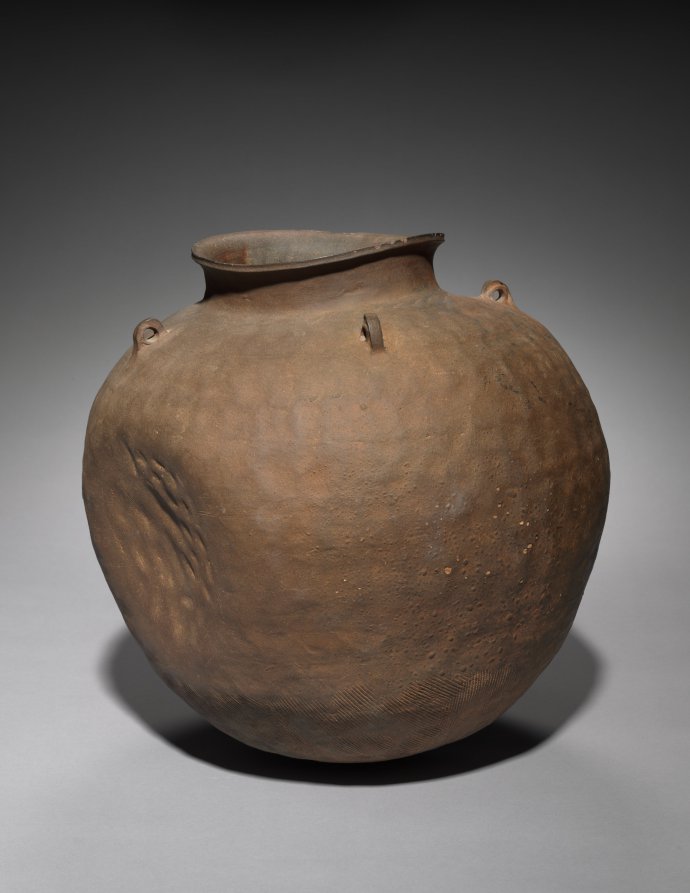
Short-necked Storage Jar (300s CE) is in the Cleveland Museum of Art collection.
The work and its context
The museum's open-access catalogue describes the work:
Early earthenware from the Three Kingdoms period is characterized by the jar's gray hue. Closed kiln chambers built on hillsides, which fired clay as high as 2000°F, maintained a low level of oxygen saturation. The loops on its round shoulder suggest that the jar once had a lid fastened by cords. The function of this type of large jar remains unknown, yet it is highly possibly that it was used to store harvested grains and seeds. The pounding technique (tanal in Korean) used to treat the surface strengthened the clay body.
Object facts
- Title: Short-necked Storage Jar
- Date: 300s CE
- Culture: Korea, Three Kingdoms period (57 BCE–668 CE)
- Type: Ceramic
- Technique: gray earthenware with impressed cord design
- Dimensions: Overall: 38 cm (14 15/16 in.); Outer diameter: 36.8 cm (14 1/2 in.)
- Collection: Korean Art
- Department: Korean Art
- Accession number: 1989.88
A detail from the museum
The surface of this pottery jar was treated by the pounding technique.
Collection credit
John L. Severance Fund
Further reading listed by the museum
- Pottery from Ancient Korea: Clay Art for Life and Death [한국고대의토기 : 흙・예술・삶과 죽음]. Seoul: National Museum of Korea, 1997.
- Yim, Seung-deok and Jeong-ho Seo. "A Study of Manufacturing Technique on the Padding Pottery in Sabi-Baekjae Period [百濟 泗沘期 打捺文土器 製作技法 硏究." Muhwa sahak (2011): 97–131.
- Kim, Yunjeong and 8 others. Hangung doja sajeon [한국 도자 사전]. Seoul: Gyeongin munhwasa, 2015.
View the collection record
See the museum's photographs and full catalogue entry. Catalogue text is reproduced from the Cleveland Museum of Art's open-access data, with HTML formatting removed. This object and its supplied image are designated CC0.
Sources
More in Lifestyle
Keep reading