Side Chair (c. 1900): Art, History and Details
Side Chair at the Cleveland Museum of Art: c. 1900, mahogany. Explore the work's context, creator attribution and collection history.
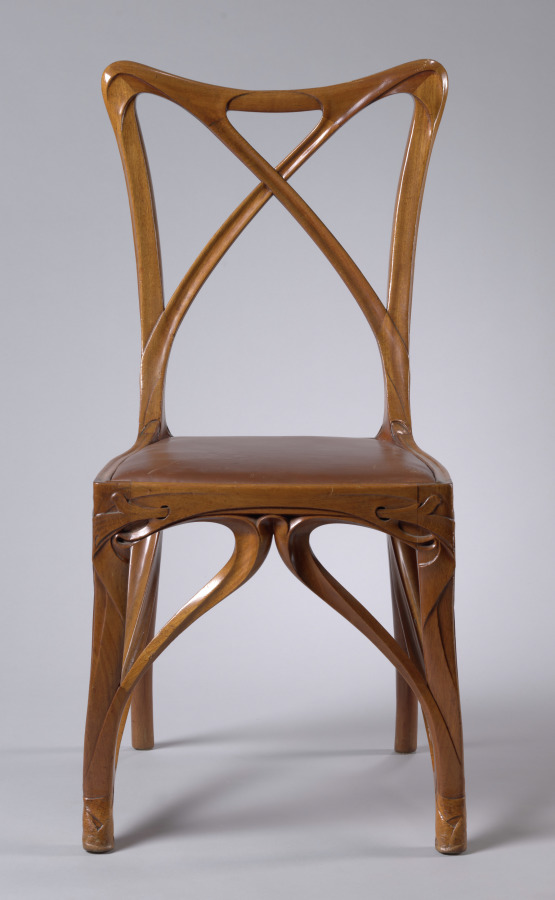
Side Chair (c. 1900) is in the Cleveland Museum of Art collection.
The work and its context
The museum's open-access catalogue describes the work:
During the 1890s a new style emerged that reflected naturalistic and symbolic motifs found in Japanese and other Asian design. This movement rejected the historicism that had dominated architecture and design during the previous decades and took hold across Europe and America too. In France the style was known as "Art Nouveau," after the name of the gallery belonging to its chief proponent Siegfried Bing, the Maison de L'Art Nouveau (House of the New Art). This side chair typifies Art Nouveau style with its curving lines that seamlessly flow from one to another. This abstract use of curvilinear lines to create form and decoration was one of the major motifs favored by art nouveau designers to evoke naturalistic or organic design. Art Nouveau reached its apex at the 1900 world's fair in Paris, which was intended to herald the new century with a new style of art. However, critics and consumers alike soon rejected Art Nouveau as too sentimental in favor of newer motifs and styles as the moment passed. By 1905 it was all but forgotten.
Object facts
- Title: Side Chair
- Date: c. 1900
- Culture: France, Paris
- Type: Furniture and woodwork
- Technique: mahogany
- Dimensions: Overall: 96.5 x 46.1 x 49.5 cm (38 x 18 1/8 x 19 1/2 in.)
- Collection: Furniture
- Department: Decorative Art and Design
- Accession number: 1982.4
A detail from the museum
This chair may have been designed by Parisian cabinetmaker Eugène Gaillard, who created a very similar design for the pavilion of Siegfried Bing at the 1900 world's fair in Paris.
Collection credit
Edwin R. and Harriet Pelton Perkins Memorial Fund
Further reading listed by the museum
- Lee, Sherman E. “Year in Review for 1982.” The Bulletin of the Cleveland Museum of Art 70, no. 1 (January 1983): 3–55.
View the collection record
See the museum's photographs and full catalogue entry. Catalogue text is reproduced from the Cleveland Museum of Art's open-access data, with HTML formatting removed. This object and its supplied image are designated CC0.
Sources
More in Lifestyle
Keep reading