Sidelocks and Elements of Wig Decoration (1980–1801 BCE): Art, History and Details
Sidelocks and Elements of Wig Decoration at the Cleveland Museum of Art: 1980–1801 BCE, Electrum (?) over a calcite gesso; silver. Explore the work's context, creator attribution and collection history.
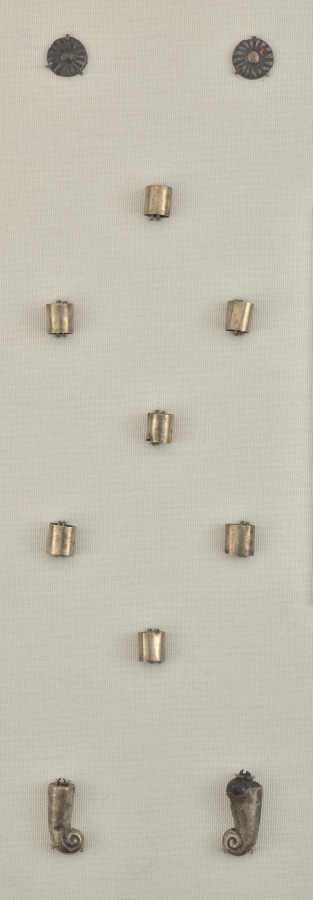
Sidelocks and Elements of Wig Decoration (1980–1801 BCE) is in the Cleveland Museum of Art collection.
The work and its context
The museum's open-access catalogue describes the work:
Elite Egyptian people once elaborately styled their hair or wore costly wigs to show their status. To further beautify their locks, women and men alike wove or sewed ornaments into their wigs or onto textiles draped over them. While most historical Egyptian wigs disintegrated over centuries, sculptures and friezes show how people wore these shining ornaments. Made from silver, curved sidelock pendants attached to braid ends or dangled on the forehead. Also of silver, tubes slid over braids or sectioned hair. Floral rosettes could have been sewn throughout, adding visual interest and reflecting the light with their faceted surfaces. While acquired together, these ornaments weren’t necessarily part of a set.
Object facts
- Title: Sidelocks and Elements of Wig Decoration
- Date: 1980–1801 BCE
- Culture: Egypt, Middle Kingdom (2040–1648 BCE), Dynasty 12
- Type: Jewelry
- Technique: Electrum (?) over a calcite gesso; silver
- Dimensions: Average: 1 cm (3/8 in.)
- Collection: Egypt - Middle Kingdom
- Department: Egyptian and Ancient Near Eastern Art
- Accession number: 1914.795
Collection credit
Gift of the John Huntington Art and Polytechnic Trust
Further reading listed by the museum
- Berman, Lawrence M., and Kenneth J. Bohač. Catalogue of Egyptian Art: The Cleveland Museum of Art. Cleveland, OH: Cleveland Museum of Art, 1999
- Ellington, Tameka N., Joseph L. Underwood, and Sarah Rogers-Lafferty. Textures: The History and Art of Black Hair. 2020.
View the collection record
See the museum's photographs and full catalogue entry. Catalogue text is reproduced from the Cleveland Museum of Art's open-access data, with HTML formatting removed. This object and its supplied image are designated CC0.
Sources
More in Lifestyle
Keep reading
Related stories


