Silk fragment with scrolling vines, grape leaves, grapes, and birds (1325–50): Art, History and Details
Silk fragment with scrolling vines, grape leaves, grapes, and birds at the Cleveland Museum of Art: 1325–50, Silk: lampas weave. Explore the work's context, creator attribution and collection history.
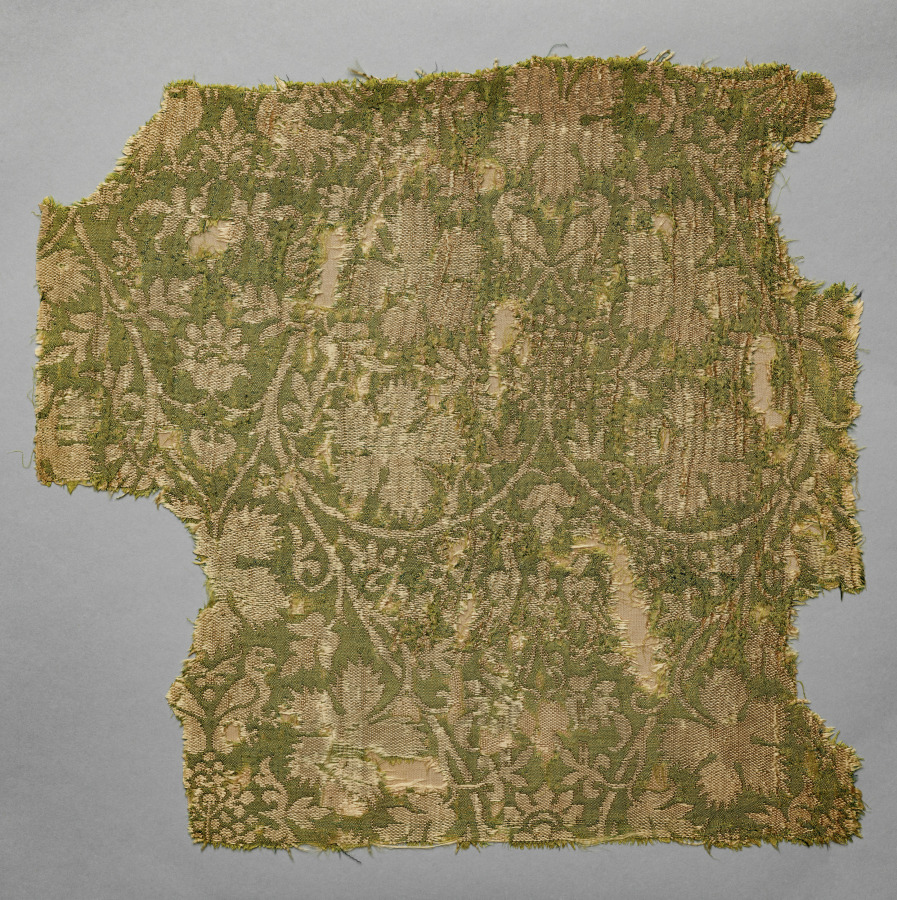
Silk fragment with scrolling vines, grape leaves, grapes, and birds (1325–50) is in the Cleveland Museum of Art collection.
The work and its context
The museum's open-access catalogue describes the work:
This silk fragment displays a revolutionary new fashion in Italian textile design, influenced by the exotic patterns in silks imported from China, Byzantium, and Islamic countries of the Middle East. Beginning in the 1320s, instead of the static arrangement of motifs stacked one above the other, Italian designers staggered the motifs, creating asymmetry and movement. Even this fragment suggests motion through the arrangement of motifs in a curved lattice layout. However, the actual motifs—the grape leaves and bunches of grapes—remain typically Italian.
Object facts
- Title: Silk fragment with scrolling vines, grape leaves, grapes, and birds
- Date: 1325–50
- Culture: Italy
- Type: Textile
- Technique: Silk: lampas weave
- Dimensions: Overall: 24.1 x 25.4 cm (9 1/2 x 10 in.); Mounted: 42.2 x 43.2 cm (16 5/8 x 17 in.)
- Collection: Textiles
- Department: Textiles
- Accession number: 1971.75
Collection credit
Florence and Charles Abel Oriental Rug Collection by exchange
Further reading listed by the museum
- Wardwell, Anne E. "Flight of the Phoenix: Crosscurrents in Late Thirteenth- to Fourteenth-Century Silk Patterns and Motifs." The Bulletin of the Cleveland Museum of Art 74, no. 1 (1987): 2-35.
- Wardwell, Anne E. "Panni Tartarici: Eastern Islamic Silks Woven with Gold and Silver (13th and 14th Centuries)." In Islamic Art III, 95-173. New York: The Islamic Art Foundation, 1989.
- Mackie, Louise W. Symbols of Power: Luxury Textiles from Islamic Lands, 7th-21st Century. Cleveland; New Haven: Cleveland Museum of Art; Yale University Press, 2015.
View the collection record
See the museum's photographs and full catalogue entry. Catalogue text is reproduced from the Cleveland Museum of Art's open-access data, with HTML formatting removed. This object and its supplied image are designated CC0.
Sources
More in Lifestyle
Keep reading