Silk Sleeve Decoration with Hunters (700s): Art, History and Details
Silk Sleeve Decoration with Hunters at the Cleveland Museum of Art: 700s, Silk: complementary weft-faced twill with inner warps (samit). Explore the work's context, creator attribution and collection history.
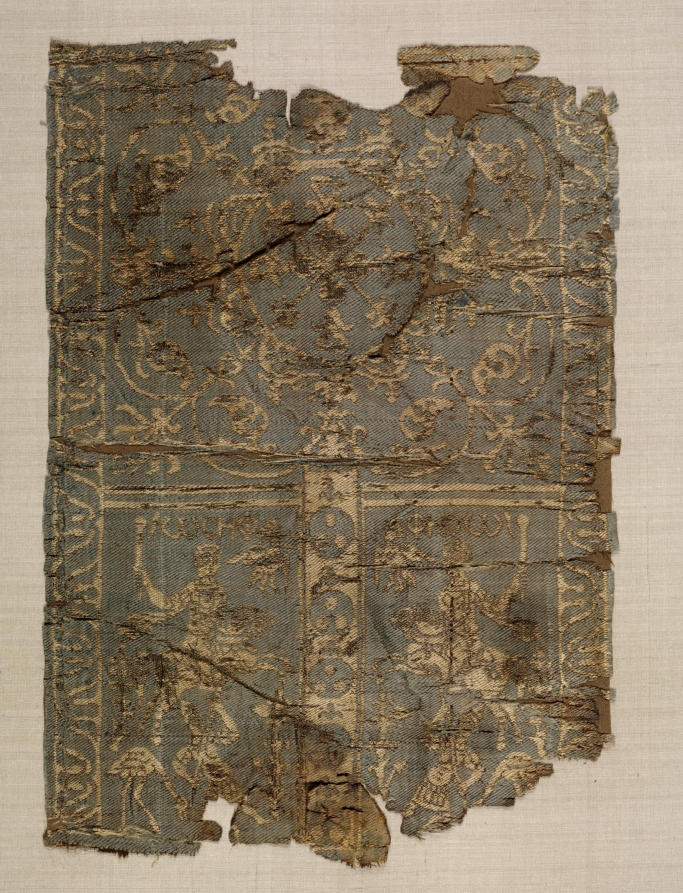
Silk Sleeve Decoration with Hunters (700s) is in the Cleveland Museum of Art collection.
The work and its context
The museum's open-access catalogue describes the work:
This silk sleeve blends technical and stylistic elements that occurred in early Islamic art. The sides of the sleeve are decorated with a lotus flower design, an ancient Egyptian motif that was absorbed into Hellenistic and Byzantine art. The upper panel displays a large medallion composed of leaves and palmettes, common vegetal motifs in Islamic art of this period. Below, the mace-wielding horseman is identified in Coptic inscriptions as Joseph, father of Jesus and saint within the Coptic faith. The image is likely derived from the Byzantine representation of the victorious emperor.
Object facts
- Title: Silk Sleeve Decoration with Hunters
- Date: 700s
- Culture: Egypt or Syria, Umayyad period (661–750) or Abbasid period (750–1258)
- Type: Textile
- Technique: Silk: complementary weft-faced twill with inner warps (samit)
- Dimensions: Overall: 28.9 x 20.3 cm (11 3/8 x 8 in.); Mounted: 37.8 x 29.2 cm (14 7/8 x 11 1/2 in.)
- Collection: T - Islamic
- Department: Textiles
- Accession number: 1947.193
A detail from the museum
At the bottom, men with spears hunt ostrich.
Collection credit
Purchase from the J. H. Wade Fund
Further reading listed by the museum
- Shepherd, Dorothy. "A Coptic Silk." The Bulletin of the Cleveland Museum of Art 34, no. 9 (1947): 216-37.
- Weibel, Adèle Coulin. Two Thousand Years of Textiles; The Figured Textiles of Europe and the Near East. New York: Published for the Detroit Institute of Arts [by] Pantheon Books, 1952.
- Akin, Esra. Muthanna / History, Theory, and Aesthetics. Bloomington, IN: Indiana University Press, 2020.
View the collection record
See the museum's photographs and full catalogue entry. Catalogue text is reproduced from the Cleveland Museum of Art's open-access data, with HTML formatting removed. This object and its supplied image are designated CC0.
Sources
More in Lifestyle
Keep reading