Silk Textile with Goatherds in a Landscape (1900s): Art, History and Details
Silk Textile with Goatherds in a Landscape at the Cleveland Museum of Art: 1900s, Silk: lampas weave. Explore the work's context, creator attribution and collection history.
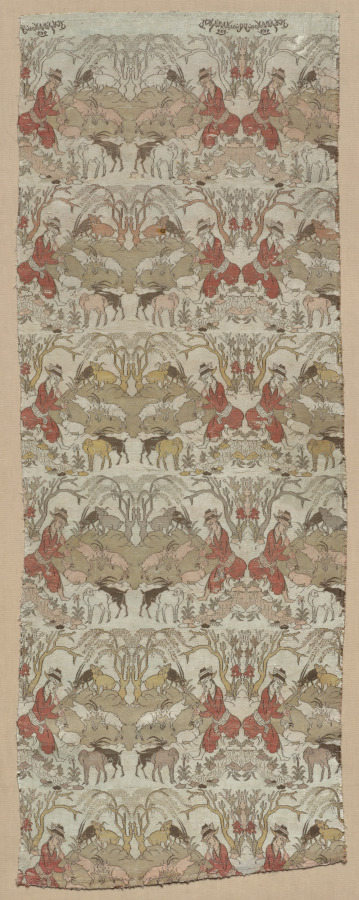
Silk Textile with Goatherds in a Landscape (1900s) is in the Cleveland Museum of Art collection.
The work and its context
The museum's open-access catalogue describes the work:
This textile has a repeated design of goatherds piping to goats in a landscape setting. At the top is an inscription reading: “Work of the servant of the court, Abū al-Quāsim Kāshānī, year 929.” In the Muslim calendar 929 is equivalent to 1523, but this fabric was woven in the 1900s. This textile emulates examples from the Safavid period (1501–1722), regarded as a high point of Iranian culture. A lampas weave is characterized by the combination of two weave structures with two sets of wefts—the threads over and under which the warp threads are woven. Threads of the pattern weft are laid on top of the background weft to form the design. Lampas is typically woven in silk, sometimes with the addition of metallic thread.
Object facts
- Title: Silk Textile with Goatherds in a Landscape
- Date: 1900s
- Culture: Iran, Isfahan
- Type: Textile
- Technique: Silk: lampas weave
- Dimensions: Overall: 101.6 x 38.7 cm (40 x 15 1/4 in.); Mounted: 113.7 x 49.5 cm (44 3/4 x 19 1/2 in.)
- Collection: T - Islamic
- Department: Textiles
- Accession number: 1978.76.a
Collection credit
Purchase from the J. H. Wade Fund
Further reading listed by the museum
- Lee, Sherman E. “The Year in Review for 1978.” The Bulletin of the Cleveland Museum of Art 66, no. 1 (January 1979): 3–47.
View the collection record
See the museum's photographs and full catalogue entry. Catalogue text is reproduced from the Cleveland Museum of Art's open-access data, with HTML formatting removed. This object and its supplied image are designated CC0.
Sources
More in Lifestyle
Keep reading