Single Leaf: Table of Consanguinity (c. 1200): Art, History and Details
Single Leaf: Table of Consanguinity at the Cleveland Museum of Art: c. 1200, ink, tempera, and gold on vellum. Explore the work's context, creator attribution and collection history.
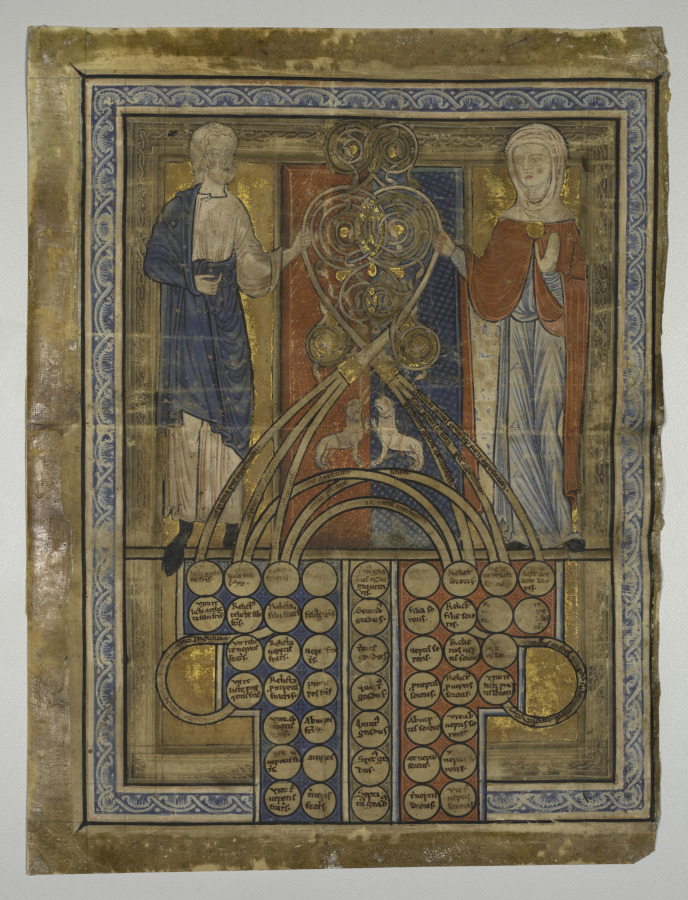
Single Leaf: Table of Consanguinity (c. 1200) is in the Cleveland Museum of Art collection.
The work and its context
The museum's open-access catalogue describes the work:
Consanguinity diagrams were used to show the degree of kinship between an individual and his or her "blood" relations. These tables followed an established tradition dating back to around AD 600. Until church law was relaxed in 1215, a marriage could only be contracted by persons separated by seven degrees of relationship. After 1215 the degree of separation was reduced to four. Tables of Consanguinity were therefore used by church officials to prove or disprove bars to marriage.
Object facts
- Title: Single Leaf: Table of Consanguinity
- Date: c. 1200
- Culture: England
- Type: Manuscript
- Technique: ink, tempera, and gold on vellum
- Dimensions: Sheet: 28.9 x 21.8 cm (11 3/8 x 8 9/16 in.)
- Collection: MED - Manuscript Illuminations
- Department: Medieval Art
- Accession number: 1924.429
Collection credit
Gift from J. H. Wade
Further reading listed by the museum
- "Illuminated Miniatures in the Cleveland Museum of Art." The Bulletin of the Cleveland Museum of Art 12, no. 4 (April 1925): 61-71
- The Cleveland Museum of Art. The Cleveland Museum of Art Handbook. Cleveland, OH: The Cleveland Museum of Art, 1958.
View the collection record
See the museum's photographs and full catalogue entry. Catalogue text is reproduced from the Cleveland Museum of Art's open-access data, with HTML formatting removed. This object and its supplied image are designated CC0.
Sources
More in Lifestyle
Keep reading