Situla (c. 525–450 BCE): Art, History and Details
Situla at the Cleveland Museum of Art: c. 525–450 BCE, bronze. Explore the work's context, creator attribution and collection history.
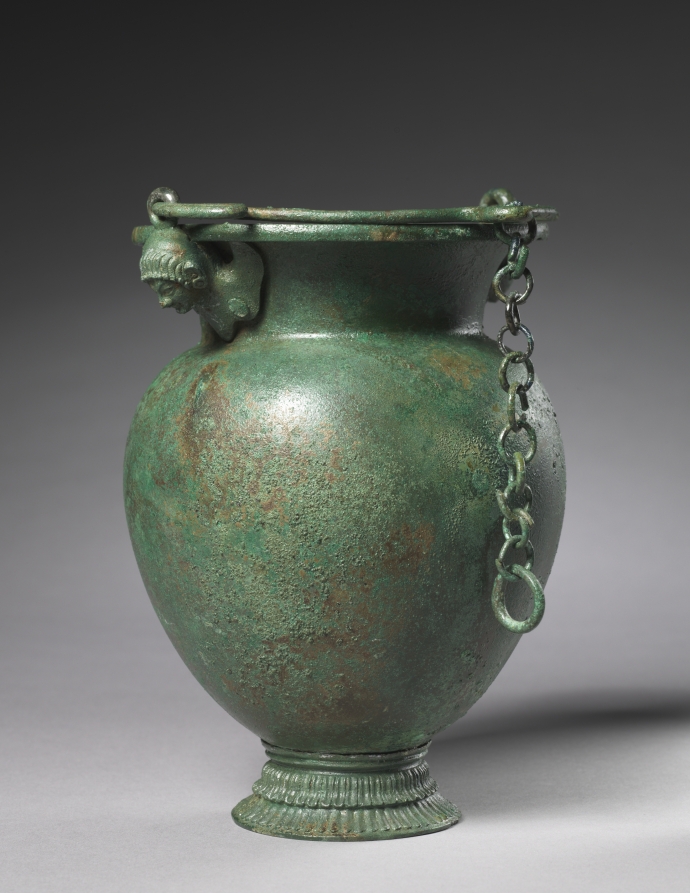
Situla (c. 525–450 BCE) is in the Cleveland Museum of Art collection.
The work and its context
The museum's open-access catalogue describes the work:
Known as a situla, or bucket, this bronze vessel features an ovoid body with a flaring neck. The separately made foot is quite elaborate and unusually shaped for this type of vessel. More typical is the handle, designed to swing upward from its two attachments, each finely cast in the form of a frontal siren with earrings and very small, simplified wings.
Object facts
- Title: Situla
- Date: c. 525–450 BCE
- Culture: Etruscan
- Type: Metalwork
- Technique: bronze
- Dimensions: without handle: 16.6 cm (6 9/16 in.)
- Collection: GR - Etruscan
- Department: Greek and Roman Art
- Accession number: 1951.28
A detail from the museum
The handle includes a loop with attached chain, perhaps meant for hanging.
Collection credit
John L. Severance Fund
Further reading listed by the museum
- Riis, P. J. "Rod-Tripods," Acta Archaeologica 10 (1939), 1-30.
- "Part II. Annual Report Issue for the Year 1951." The Bulletin of the Cleveland Museum of Art 39, no. 6 (1952): 131-66.
- Riis, P. J. Vulcientia Vetustiora: A Study of Archaic Vulcian Bronzes. [Copenhagen]: Royal Danish Academy of Sciences and Letters, 1998.
View the collection record
See the museum's photographs and full catalogue entry. Catalogue text is reproduced from the Cleveland Museum of Art's open-access data, with HTML formatting removed. This object and its supplied image are designated CC0.
Sources
More in Lifestyle
Keep reading