Slendang (Shoulder Cloth) (1800s–early 1900s): Art, History and Details
Slendang (Shoulder Cloth) at the Cleveland Museum of Art: 1800s–early 1900s, tabby weave, batik; cotton. Explore the work's context, creator attribution and collection history.
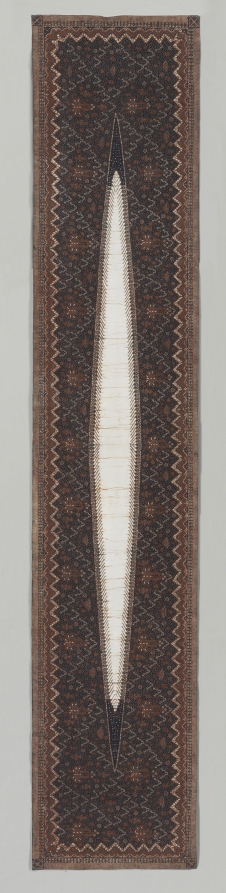
Slendang (Shoulder Cloth) (1800s–early 1900s) is in the Cleveland Museum of Art collection.
The work and its context
The museum's open-access catalogue describes the work:
Batik is an ancient technique that was practiced in India and throughout much of Southeast Asia. With the invention of the "canting" (a tool used to apply hot wax to fabric) in the 17th - 18th centuries, however, batik bacame a particular speciality of Java. This batik was produced in the central regions of Java where cloths were resist-dyed with traditional designs in white, indigo blue, and dark brown. The stylized wing and tail of the mythical bird Garuda and the sacred mountains seen here had cosmic significance and were reserved for textiles worn by nobility for ceremonial occasions or for dance costumes. The white, elongated diamond-shaped center is unique to batik shoulder cloths.
Object facts
- Title: Slendang (Shoulder Cloth)
- Date: 1800s–early 1900s
- Culture: Indonesia, Central Java, 19th - early 20th century
- Type: Textile
- Technique: tabby weave, batik; cotton
- Dimensions: Overall: 271 x 53.3 cm (106 11/16 x 21 in.)
- Collection: Textiles
- Department: Textiles
- Accession number: 1917.31
Collection credit
Gift of Mrs. James J. Tracy
View the collection record
See the museum's photographs and full catalogue entry. Catalogue text is reproduced from the Cleveland Museum of Art's open-access data, with HTML formatting removed. This object and its supplied image are designated CC0.
Sources
More in Lifestyle
Keep reading


