Snakeshead (Early 20th century): Art, History and Details
Snakeshead at the Cleveland Museum of Art: Early 20th century, plain weave cotton, printed. Explore the work's context, creator attribution and collection history.
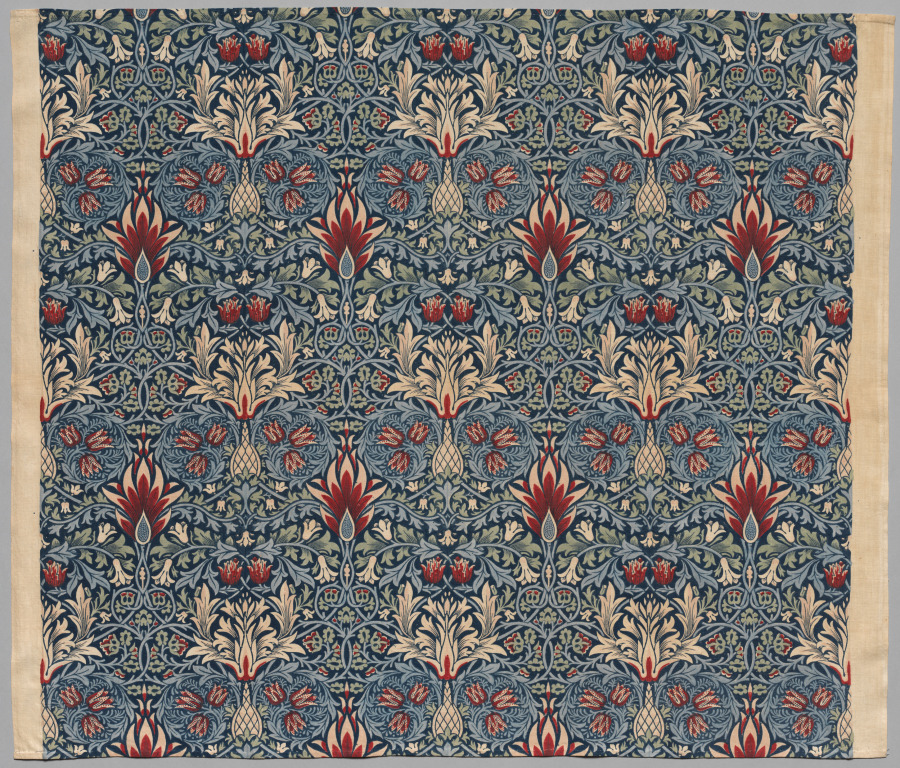
Snakeshead (Early 20th century) is in the Cleveland Museum of Art collection. The museum's creator attribution is William Morris (British, 1834–1896).
The work and its context
The museum's open-access catalogue describes the work:
When Morris designed Snakeshead in 1877, Indian silks were in style and widely imported from British India. This design stands out for its diminutive motifs and the strong red and black colors, which were fashionable only for a short time before paler hues regained favor with clients. While its color scheme suggests distant lands with warmer climates, the pattern showcases one of Morris’s favorite flowers: the fritillary, a wildflower that he remembered growing in the meadows near Oxford.
Object facts
- Title: Snakeshead
- Date: Early 20th century
- Creator attribution: William Morris (British, 1834–1896)
- Culture: England, Walthamstow, Early 20th century
- Type: Textile
- Technique: plain weave cotton, printed
- Dimensions: Overall: 85.1 x 100.3 cm (33 1/2 x 39 1/2 in.)
- Collection: Textiles
- Department: Textiles
- Accession number: 1937.695
Collection credit
Gift of Mrs. Henry Chisholm
Further reading listed by the museum
- Parry, Linda. William Morris Textiles. London: Weidenfeld and Nicolson, 1983.
- Korkow, Cory. "Textiles." IN William Morris: Designing an Earthly Paradise. Cory Korkow and Victoria Hepburn, 8-23. Cleveland, Ohio : Cleveland Museum of Art, 2017.
View the collection record
See the museum's photographs and full catalogue entry. Catalogue text is reproduced from the Cleveland Museum of Art's open-access data, with HTML formatting removed. This object and its supplied image are designated CC0.
Sources
More in Lifestyle
Keep reading